How Much Do You Need to Know to Trade Options
In finance, an option is a contract which conveys to its owner, the holder, the right, but non the obligation, to buy or sell an underlying asset or musical instrument at a specified strike price on or before a specified date, depending on the fashion of the option. Options are typically acquired by buy, equally a form of bounty, or every bit role of a complex fiscal transaction. Thus, they are also a form of asset and have a valuation that may depend on a complex relationship between underlying nugget value, time until expiration, market volatility, and other factors. Options may be traded betwixt private parties in over-the-counter (OTC) transactions, or they may be commutation-traded in live, orderly markets in the form of standardized contracts.
Definition and awarding [edit]
An pick is a contract that allows the holder the right to buy or sell an underlying asset or financial instrument at a specified strike price on or earlier a specified appointment, depending on the form of the selection. The strike price may be set by reference to the spot toll (market toll) of the underlying security or article on the twenty-four hours an option is issued, or information technology may be fixed at a disbelieve or at a premium. The issuer has the corresponding obligation to fulfill the transaction (to sell or buy) if the holder "exercises" the choice. An choice that conveys to the holder the right to buy at a specified price is referred to as a call, while one that conveys the correct to sell at a specified price is known as a put.
The issuer may grant an option to a buyer every bit part of some other transaction (such equally a share consequence or as part of an employee incentive scheme), or the buyer may pay a premium to the issuer for the option. A call option would normally be exercised merely when the strike price is below the market value of the underlying asset, while a put choice would normally be exercised only when the strike toll is above the marketplace value. When an selection is exercised, the cost to the pick holder is the strike price of the asset acquired plus the premium, if any, paid to the issuer. If the option'south expiration engagement passes without the pick being exercised, the option expires, and the holder forfeits the premium paid to the issuer. In whatsoever example, the premium is income to the issuer, and normally a uppercase loss to the option holder.
The holder of an option may on-sell the choice to a third party in a secondary market place, in either an over-the-counter transaction or on an options commutation, depending on the option. The market price of an American-style option normally closely follows that of the underlying stock being the divergence between the marketplace price of the stock and the strike price of the choice. The actual marketplace cost of the option may vary depending on a number of factors, such equally a significant choice holder needing to sell the option due to the expiration date budgeted and not having the financial resources to exercise the option, or a buyer in the market place trying to aggregate a big option belongings. The ownership of an pick does non generally entitle the holder to any rights associated with the underlying asset, such as voting rights or any income from the underlying nugget, such every bit a dividend.
History [edit]
Historical uses of options [edit]
Contracts similar to options take been used since ancient times.[1] The first reputed option buyer was the aboriginal Greek mathematician and philosopher Thales of Miletus. On a certain occasion, information technology was predicted that the flavour's olive harvest would be larger than usual, and during the off-flavor, he acquired the correct to use a number of olive presses the following leap. When leap came and the olive harvest was larger than expected, he exercised his options and and then rented the presses out at a much higher price than he paid for his 'option'.[2] [three]
The 1688 book Defoliation of Confusions describes the trading of "opsies" on the Amsterdam stock exchange, explaining that "in that location will be only limited risks to you, while the proceeds may surpass all your imaginings and hopes."[iv]
In London, puts and "refusals" (calls) first became well-known trading instruments in the 1690s during the reign of William and Mary.[v] Privileges were options sold over the counter in nineteenth century America, with both puts and calls on shares offered by specialized dealers. Their exercise price was stock-still at a rounded-off market price on the day or week that the option was bought, and the expiry date was generally three months after purchase. They were non traded in secondary markets.
In the real estate market, call options have long been used to assemble large parcels of country from split owners; e.chiliad., a developer pays for the right to buy several side by side plots, simply is not obligated to buy these plots and might not unless they tin can buy all the plots in the entire parcel.
In the movement pic industry, flick or theatrical producers often buy an option giving the right — but non the obligation — to dramatize a specific volume or script.
Lines of credit requite the potential borrower the correct — merely not the obligation — to borrow within a specified fourth dimension period.
Many choices, or embedded options, have traditionally been included in bond contracts. For instance, many bonds are convertible into common stock at the heir-apparent's pick, or may be chosen (bought back) at specified prices at the issuer's choice. Mortgage borrowers have long had the option to repay the loan early, which corresponds to a callable bond option.
Modern stock options [edit]
Options contracts have been known for decades. The Chicago Lath Options Commutation was established in 1973, which set up a regime using standardized forms and terms and trade through a guaranteed clearing house. Trading activity and academic interest has increased since then.
Today, many options are created in a standardized class and traded through clearing houses on regulated options exchanges, while other over-the-counter options are written as bilateral, customized contracts betwixt a single buyer and seller, i or both of which may be a dealer or market-maker. Options are function of a larger class of fiscal instruments known as derivative products, or just, derivatives.[6] [7]
Contract specifications [edit]
A financial option is a contract between two counterparties with the terms of the option specified in a term sheet. Pick contracts may be quite complicated; however, at minimum, they commonly contain the post-obit specifications:[8]
- whether the selection holder has the right to buy (a call option) or the right to sell (a put choice)
- the quantity and class of the underlying nugget(due south) (e.g., 100 shares of XYZ Co. B stock)
- the strike price, also known as the exercise price, which is the cost at which the underlying transaction will occur upon practice
- the expiration engagement, or expiry, which is the last date the option tin can be exercised
- the settlement terms, for instance whether the writer must deliver the actual asset on exercise, or may simply tender the equivalent cash amount
- the terms by which the option is quoted in the market to convert the quoted cost into the actual premium – the total corporeality paid by the holder to the writer
Pick trading [edit]
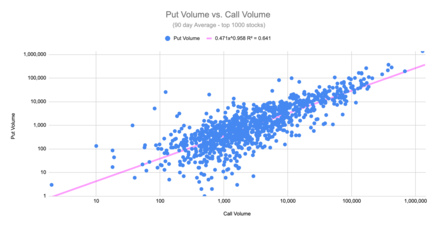
Put Volume vs. Call Volume (xc Day Average Book)
Forms of trading [edit]
Exchange-traded options [edit]
Exchange-traded options (also chosen "listed options") are a class of exchange-traded derivatives. Exchange-traded options have standardized contracts, and are settled through a clearing business firm with fulfillment guaranteed past the Options Immigration Corporation (OCC). Since the contracts are standardized, accurate pricing models are oft available. Exchange-traded options include:[9] [10]
- Stock options
- Bond options and other interest rate options
- Stock market index options or, simply, alphabetize options and
- Options on futures contracts
- Callable bull/comport contract
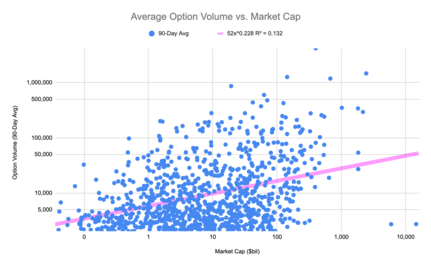
Average Option Volume (ninety days) vs Market Capitalization
Over-the-counter options [edit]
Over-the-counter options (OTC options, besides called "dealer options") are traded between two private parties, and are not listed on an exchange. The terms of an OTC option are unrestricted and may be individually tailored to meet any business need. In full general, the option writer is a well-capitalized institution (in order to preclude the credit risk). Choice types commonly traded over the counter include:
- Involvement rate options
- Currency cantankerous rate options, and
- Options on swaps or swaptions.
By avoiding an exchange, users of OTC options tin can narrowly tailor the terms of the choice contract to conform individual business requirements. In addition, OTC option transactions generally do not demand to be advertised to the market and face trivial or no regulatory requirements. However, OTC counterparties must establish credit lines with each other, and arrange to each other'south clearing and settlement procedures.
With few exceptions,[11] there are no secondary markets for employee stock options. These must either exist exercised by the original grantee or allowed to elapse.
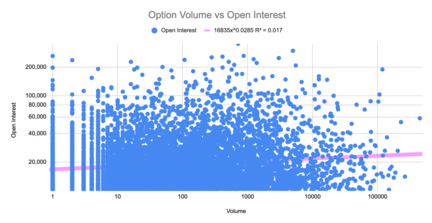
Choice Volume vs Open Interest (for 7000+ Contracts)
Exchange trading [edit]
The almost mutual way to trade options is via standardized options contracts that are listed by diverse futures and options exchanges. [12] Listings and prices are tracked and can exist looked up by ticker symbol. By publishing continuous, alive markets for option prices, an exchange enables contained parties to engage in price discovery and execute transactions. Every bit an intermediary to both sides of the transaction, the benefits the exchange provides to the transaction include:
- Fulfillment of the contract is backed by the credit of the exchange, which typically has the highest rating (AAA),
- Counterparties remain anonymous,
- Enforcement of market regulation to ensure fairness and transparency, and
- Maintenance of orderly markets, particularly during fast trading weather.

Days till Expiration vs Option Volume (7000+ contracts)
Bones trades (American style) [edit]
These trades are described from the bespeak of view of a speculator. If they are combined with other positions, they can also be used in hedging. An option contract in U.s. markets usually represents 100 shares of the underlying security.[xiii] [14]
Long call [edit]
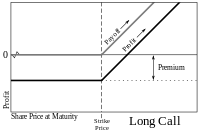
Payoff from buying a call.
A trader who expects a stock's price to increment tin buy a phone call option to purchase the stock at a stock-still toll (strike price) at a afterward date, rather than purchase the stock outright. The cash outlay on the option is the premium. The trader would have no obligation to purchase the stock, but only has the right to do so on or before the expiration engagement. The chance of loss would exist express to the premium paid, unlike the possible loss had the stock been bought outright.
The holder of an American-style call option tin sell the selection holding at any fourth dimension until the expiration date, and would consider doing so when the stock's spot cost is above the exercise price, especially if the holder expects the cost of the option to drop. By selling the selection early on in that situation, the trader can realise an immediate turn a profit. Alternatively, the trader can exercise the pick — for example, if at that place is no secondary market for the options — and then sell the stock, realising a profit. A trader would make a profit if the spot price of the shares rises by more than the premium. For example, if the exercise price is 100 and premium paid is 10, and so if the spot toll of 100 rises to but 110 the transaction is intermission-even; an increase in stock price above 110 produces a profit.
If the stock price at expiration is lower than the exercise price, the holder of the selection at that fourth dimension will let the call contract expire and lose only the premium (or the toll paid on transfer).
Long put [edit]
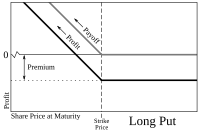
A trader who expects a stock's price to decrease tin buy a put choice to sell the stock at a fixed toll (strike price) at a afterward engagement. The trader is under no obligation to sell the stock, but has the right to do and so on or before the expiration appointment. If the stock toll at expiration is below the exercise price by more than the premium paid, the trader makes a profit. If the stock price at expiration is above the exercise cost, the trader lets the put contract expire, and loses only the premium paid. In the transaction, the premium also plays a office equally it enhances the break-fifty-fifty betoken. For example, if the exercise price is 100 and the premium paid is 10, so a spot price betwixt 90 and 100 is not profitable. The trader makes a profit only if the spot cost is below 90.
The trader exercising a put option on a stock does not need to own the underlying asset, considering well-nigh stocks tin be shorted.
Brusque telephone call [edit]

Payoff from writing a call.
A trader who expects a stock's price to decrease tin can sell the stock short or instead sell, or "write", a telephone call. The trader selling a call has an obligation to sell the stock to the call buyer at a fixed price ("strike toll"). If the seller does non own the stock when the option is exercised, they are obligated to purchase the stock in the market place at the prevailing market toll. If the stock price decreases, the seller of the telephone call (phone call author) makes a turn a profit in the corporeality of the premium. If the stock price increases over the strike price by more than the amount of the premium, the seller loses money, with the potential loss existence unlimited.
Short put [edit]
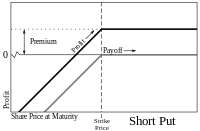
Payoff from writing a put.
A trader who expects a stock'southward price to increase tin buy the stock or instead sell, or "write", a put. The trader selling a put has an obligation to buy the stock from the put buyer at a fixed cost ("strike price"). If the stock toll at expiration is above the strike price, the seller of the put (put writer) makes a profit in the amount of the premium. If the stock price at expiration is beneath the strike toll past more than the amount of the premium, the trader loses money, with the potential loss being upwardly to the strike cost minus the premium. A criterion alphabetize for the operation of a cash-secured short put option position is the CBOE S&P 500 PutWrite Index (ticker PUT).
Options strategies [edit]
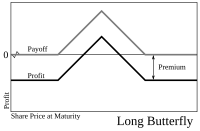
Payoffs from buying a butterfly spread.

Payoffs from selling a straddle.

Payoffs from a covered call.
Combining whatsoever of the four basic kinds of pick trades (peradventure with different exercise prices and maturities) and the 2 basic kinds of stock trades (long and short) allows a variety of options strategies. Elementary strategies usually combine only a few trades, while more complicated strategies can combine several.
Strategies are oft used to engineer a particular risk profile to movements in the underlying security. For example, buying a butterfly spread (long i X1 call, brusk ii X2 calls, and long one X3 call) allows a trader to turn a profit if the stock price on the expiration engagement is most the middle exercise price, X2, and does non expose the trader to a large loss.
A condor is a strategy that is like to a butterfly spread, but with different strikes for the short options – offering a larger likelihood of profit but with a lower internet credit compared to the butterfly spread.
Selling a straddle (selling both a put and a phone call at the same do cost) would give a trader a greater profit than a butterfly if the final stock price is near the exercise price, but might result in a big loss.
Similar to the straddle is the strangle which is also constructed by a call and a put, but whose strikes are different, reducing the net debit of the trade, merely likewise reducing the take a chance of loss in the trade.
One well-known strategy is the covered call, in which a trader buys a stock (or holds a previously-purchased long stock position), and sells a call. (This can be contrasted with a naked telephone call. See also naked put.) If the stock price rises to a higher place the exercise price, the telephone call will be exercised and the trader volition become a fixed profit. If the stock price falls, the phone call volition non be exercised, and any loss incurred to the trader will be partially offset by the premium received from selling the telephone call. Overall, the payoffs match the payoffs from selling a put. This relationship is known as put–telephone call parity and offers insights for financial theory. A benchmark index for the functioning of a buy-write strategy is the CBOE South&P 500 BuyWrite Index (ticker symbol BXM).
Another very common strategy is the protective put, in which a trader buys a stock (or holds a previously-purchased long stock position), and buys a put. This strategy acts as an insurance when investing on the underlying stock, hedging the investor'south potential losses, but also shrinking an otherwise larger profit, if just purchasing the stock without the put. The maximum turn a profit of a protective put is theoretically unlimited as the strategy involves being long on the underlying stock. The maximum loss is limited to the purchase price of the underlying stock less the strike price of the put choice and the premium paid. A protective put is also known equally a married put.
Types [edit]
Options tin be classified in a few ways.
According to the choice rights [edit]
- Call options give the holder the right—but non the obligation—to buy something at a specific toll for a specific fourth dimension menstruum.
- Put options give the holder the correct—but not the obligation—to sell something at a specific price for a specific time period.
According to the underlying assets [edit]
- Equity option
- Bond option
- Future selection
- Index selection
- Commodity option
- Currency option
- Bandy option
Other option types [edit]
Another important class of options, especially in the U.Southward., are employee stock options, which are awarded past a company to their employees as a form of incentive compensation. Other types of options exist in many financial contracts, for example real estate options are ofttimes used to assemble large parcels of land, and prepayment options are usually included in mortgage loans. However, many of the valuation and risk direction principles utilize across all financial options.
Selection styles [edit]
Options are classified into a number of styles, the about common of which are:
- American option – an pick that may be exercised on any trading twenty-four hours on or before expiration.
- European option – an option that may only exist exercised on decease.
These are often described equally vanilla options. Other styles include:
- Bermudan option – an selection that may be exercised simply on specified dates on or before expiration.
- Asian choice – an option whose payoff is determined by the average underlying toll over some preset time menstruum.
- Barrier option – any option with the general characteristic that the underlying security's price must pass a sure level or "barrier" before it can be exercised.
- Binary option – An all-or-aught choice that pays the full amount if the underlying security meets the defined status on expiration otherwise it expires.
- Exotic choice – whatsoever of a broad category of options that may include complex financial structures.[15]
Valuation [edit]
Considering the values of selection contracts depend on a number of different variables in addition to the value of the underlying asset, they are circuitous to value. There are many pricing models in use, although all essentially contain the concepts of rational pricing (i.e. risk neutrality), moneyness, option time value, and put–telephone call parity.
The valuation itself combines a model of the behavior ("process") of the underlying price with a mathematical method which returns the premium equally a function of the assumed behavior. The models range from the (prototypical) Black–Scholes model for equities,[sixteen] [ unreliable source? ] [17] to the Heath–Jarrow–Morton framework for involvement rates, to the Heston model where volatility itself is considered stochastic. Run into Asset pricing for a list of the various models here.
Bones decomposition [edit]
In its most basic terms, the value of an selection is commonly decomposed into two parts:
- The start part is the intrinsic value, which is divers as the departure between the market value of the underlying, and the strike price of the given option
- The second function is the time value, which depends on a set of other factors which, through a multi-variable, non-linear interrelationship, reflect the discounted expected value of that divergence at expiration.
Valuation models [edit]
Every bit higher up, the value of the option is estimated using a variety of quantitative techniques, all based on the principle of risk-neutral pricing, and using stochastic calculus in their solution. The most basic model is the Blackness–Scholes model. More sophisticated models are used to model the volatility grinning. These models are implemented using a variety of numerical techniques.[18] In general, standard option valuation models depend on the following factors:
- The current market place price of the underlying security
- The strike price of the option, particularly in relation to the current market cost of the underlying (in the money vs. out of the coin)
- The cost of holding a position in the underlying security, including interest and dividends
- The fourth dimension to expiration together with any restrictions on when practise may occur
- an estimate of the time to come volatility of the underlying security'southward price over the life of the option
More than advanced models tin require additional factors, such as an estimate of how volatility changes over time and for diverse underlying price levels, or the dynamics of stochastic interest rates.
The following are some of the principal valuation techniques used in practice to evaluate option contracts.
Blackness–Scholes [edit]
Post-obit early on piece of work past Louis Bachelier and later on work past Robert C. Merton, Fischer Black and Myron Scholes fabricated a major breakthrough by deriving a differential equation that must be satisfied by the toll of whatever derivative dependent on a non-dividend-paying stock. Past employing the technique of constructing a risk neutral portfolio that replicates the returns of holding an pick, Blackness and Scholes produced a closed-form solution for a European pick'south theoretical price.[xix] At the same time, the model generates hedge parameters necessary for constructive risk management of option holdings.
While the ideas behind the Blackness–Scholes model were ground-breaking and somewhen led to Scholes and Merton receiving the Swedish Central Bank'southward associated Prize for Accomplishment in Economics (a.thou.a., the Nobel Prize in Economics),[xx] the application of the model in bodily options trading is clumsy because of the assumptions of continuous trading, constant volatility, and a constant interest rate. Nevertheless, the Black–Scholes model is even so one of the most important methods and foundations for the existing fiscal market in which the result is within the reasonable range.[21]
Stochastic volatility models [edit]
Since the market crash of 1987, it has been observed that market unsaid volatility for options of lower strike prices are typically higher than for higher strike prices, suggesting that volatility varies both for time and for the price level of the underlying security – a so-called volatility smile; and with a time dimension, a volatility surface.
The main arroyo here is to treat volatility as stochastic, with the resultant Stochastic volatility models, and the Heston model as prototype;[22] encounter #Take a chance-neutral_measure for a discussion of the logic. Other models include the CEV and SABR volatility models. One principal advantage of the Heston model, even so, is that it can be solved in closed-form, while other stochastic volatility models require complex numerical methods.[22]
An alternate, though related, approach is to apply a local volatility model, where volatility is treated as a deterministic role of both the current asset level and of time . As such, a local volatility model is a generalisation of the Black–Scholes model, where the volatility is a constant. The concept was developed when Bruno Dupire[23] and Emanuel Derman and Iraj Kani[24] noted that there is a unique improvidence process consistent with the run a risk neutral densities derived from the market place prices of European options. See #Development for give-and-take.


Curt-rate models [edit]
For the valuation of bond options, swaptions (i.e. options on swaps), and interest rate cap and floors (effectively options on the interest rate) diverse curt-charge per unit models have been developed (applicable, in fact, to interest rate derivatives generally). The all-time known of these are Black-Derman-Toy and Hull–White.[25] These models describe the time to come evolution of interest rates past describing the time to come evolution of the short charge per unit. The other major framework for interest rate modelling is the Heath–Jarrow–Morton framework (HJM). The stardom is that HJM gives an analytical description of the unabridged yield curve, rather than just the brusque rate. (The HJM framework incorporates the Brace–Gatarek–Musiela model and market models. And some of the short rate models tin can be straightforwardly expressed in the HJM framework.) For some purposes, e.1000., valuation of mortgage-backed securities, this can be a big simplification; regardless, the framework is oft preferred for models of college dimension. Note that for the simpler options here, i.eastward. those mentioned initially, the Black model can instead be employed, with certain assumptions.
Model implementation [edit]
Once a valuation model has been chosen, there are a number of different techniques used to implement the models.
Analytic techniques [edit]
In some cases, ane can take the mathematical model and using belittling methods, develop closed form solutions such as the Black–Scholes model and the Black model. The resulting solutions are readily computable, as are their "Greeks". Although the Curlicue–Geske–Whaley model applies to an American telephone call with one dividend, for other cases of American options, closed class solutions are not available; approximations here include Barone-Adesi and Whaley, Bjerksund and Stensland and others.
Binomial tree pricing model [edit]
Closely following the derivation of Black and Scholes, John Cox, Stephen Ross and Marking Rubinstein developed the original version of the binomial options pricing model.[26] [27] Information technology models the dynamics of the selection's theoretical value for discrete time intervals over the option'southward life. The model starts with a binomial tree of detached time to come possible underlying stock prices. By constructing a riskless portfolio of an option and stock (as in the Black–Scholes model) a simple formula can be used to notice the option price at each node in the tree. This value can estimate the theoretical value produced by Black–Scholes, to the desired caste of precision. However, the binomial model is considered more than accurate than Black–Scholes considering it is more than flexible; east.g., discrete time to come dividend payments tin can be modeled correctly at the proper frontwards fourth dimension steps, and American options tin can exist modeled every bit well as European ones. Binomial models are widely used past professional option traders. The Trinomial tree is a similar model, allowing for an upwardly, down or stable path; although considered more accurate, especially when fewer time-steps are modelled, it is less commonly used as its implementation is more complex. For a more than general give-and-take, as well equally for awarding to commodities, interest rates and hybrid instruments, see Lattice model (finance).
Monte Carlo models [edit]
For many classes of options, traditional valuation techniques are intractable considering of the complexity of the musical instrument. In these cases, a Monte Carlo arroyo may oft be useful. Rather than attempt to solve the differential equations of motion that describe the option's value in relation to the underlying security's price, a Monte Carlo model uses simulation to generate random cost paths of the underlying nugget, each of which results in a payoff for the selection. The average of these payoffs tin exist discounted to yield an expectation value for the option.[28] Note though, that despite its flexibility, using simulation for American styled options is somewhat more than circuitous than for lattice based models.
Finite deviation models [edit]
The equations used to model the option are often expressed as partial differential equations (run into for case Blackness–Scholes equation). Once expressed in this form, a finite difference model can exist derived, and the valuation obtained. A number of implementations of finite difference methods exist for option valuation, including: explicit finite divergence, implicit finite divergence and the Crank–Nicolson method. A trinomial tree option pricing model tin can be shown to be a simplified application of the explicit finite departure method. Although the finite departure approach is mathematically sophisticated, it is particularly useful where changes are assumed over time in model inputs – for case dividend yield, chance-costless charge per unit, or volatility, or some combination of these – that are non tractable in closed form.
Other models [edit]
Other numerical implementations which have been used to value options include finite element methods.
Risks [edit]
A call choice (also known as a CO) expiring in 99 days on 100 shares of XYZ stock is struck at $fifty, with XYZ currently trading at $48. With time to come realized volatility over the life of the option estimated at 25%, the theoretical value of the option is $1.89. The hedge parameters , , , are (0.439, 0.0631, 9.6, and −0.022), respectively. Assume that on the following day, XYZ stock rises to $48.5 and volatility falls to 23.v%. We tin can calculate the estimated value of the call option by applying the hedge parameters to the new model inputs equally:



Under this scenario, the value of the option increases by $0.0614 to $1.9514, realizing a turn a profit of $6.xiv. Note that for a delta neutral portfolio, whereby the trader had also sold 44 shares of XYZ stock every bit a hedge, the net loss under the same scenario would exist ($15.86).
Equally with all securities, trading options entails the gamble of the option'due south value changing over time. Even so, unlike traditional securities, the render from holding an option varies non-linearly with the value of the underlying and other factors. Therefore, the risks associated with holding options are more complicated to understand and predict.
In general, the change in the value of an pick can be derived from Itô's lemma as:

where the Greeks , , and are the standard hedge parameters calculated from an option valuation model, such as Black–Scholes, and , and are unit of measurement changes in the underlying's cost, the underlying's volatility and time, respectively.


Thus, at whatsoever betoken in time, one can estimate the take chances inherent in holding an selection by calculating its hedge parameters and and then estimating the expected change in the model inputs, , and , provided the changes in these values are minor. This technique can be used finer to empathize and manage the risks associated with standard options. For example, past offsetting a holding in an option with the quantity of shares in the underlying, a trader tin form a delta neutral portfolio that is hedged from loss for modest changes in the underlying'south price. The corresponding price sensitivity formula for this portfolio is:



Pin risk [edit]
A special state of affairs called pin risk tin arise when the underlying closes at or very close to the pick's strike value on the last 24-hour interval the option is traded prior to expiration. The choice writer (seller) may non know with certainty whether or not the choice will actually exist exercised or be allowed to elapse. Therefore, the option author may finish up with a big, unwanted balance position in the underlying when the markets open on the next trading solar day after expiration, regardless of his or her all-time efforts to avoid such a residual.
Counterparty run a risk [edit]
A further, often ignored, risk in derivatives such as options is counterparty risk. In an option contract this run a risk is that the seller won't sell or buy the underlying asset every bit agreed. The risk can exist minimized by using a financially potent intermediary able to brand adept on the trade, only in a major panic or crash the number of defaults tin can overwhelm even the strongest intermediaries.
Meet also [edit]
- American Stock Exchange
- Area yield options contract
- Ascot (finance)
- Chicago Board Options Commutation
- Dilutive security
- Eurex
- Euronext.liffe
- International Securities Exchange
- NYSE Arca
- Philadelphia Stock Commutation
- LEAPS (finance)
- Options backdating
- Options Clearing Corporation
- Options spread
- Options strategy
- Option symbol
- Real options analysis
- PnL Explained
- Pin risk (options)
- XVA
References [edit]
- ^ Abraham, Stephan (May xiii, 2010). "History of Financial Options - Investopedia". Investopedia . Retrieved June 2, 2014.
- ^ Mattias Sander. Bondesson'south Representation of the Variance Gamma Model and Monte Carlo Option Pricing. Lunds Tekniska Högskola 2008
- ^ Aristotle. Politics.
- ^ Josef de la Vega. Confusion de Confusiones. 1688. Portions Descriptive of the Amsterdam Stock Substitution Selected and Translated by Professor Hermann Kellenbenz. Baker Library, Harvard Graduate School Of Business Administration, Boston, Massachusetts.
- ^ Smith, B. Mark (2003), History of the Global Stock Market place from Ancient Rome to Silicon Valley, Academy of Chicago Press, p. xx, ISBN0-226-76404-4
- ^ Brealey, Richard A.; Myers, Stewart (2003), Principles of Corporate Finance (7th ed.), McGraw-Colina, Affiliate 20
- ^ Hull, John C. (2005), Options, Futures and Other Derivatives (excerpt past Fan Zhang) (6th ed.), Pg 6: Prentice-Hall, ISBN0-13-149908-4
{{citation}}: CS1 maint: location (link) - ^ Characteristics and Risks of Standardized Options, Options Immigration Corporation, retrieved July xv, 2020
- ^ Trade CME Products, Chicago Mercantile Commutation, retrieved June 21, 2007
- ^ ISE Traded Products, International Securities Exchange, archived from the original on May eleven, 2007, retrieved June 21, 2007
- ^ Elinor Mills (December 12, 2006), Google unveils unorthodox stock option auction, CNet, retrieved June 19, 2007
- ^ Harris, Larry (2003), Trading and Exchanges, Oxford University Press, pp.26–27
- ^ invest-faq or Law & Valuation for typical size of option contract
- ^ "Understanding Stock Options" (PDF). The Options Clearing Corporation and CBOE. Retrieved August 27, 2015.
- ^ Fabozzi, Frank J. (2002). The Handbook of Financial Instruments (1st ed.). New Bailiwick of jersey: John Wiley and Sons. p. 471. ISBN0-471-22092-2.
- ^ Benhamou, Eric. "Options pre-Blackness Scholes" (PDF).
- ^ Black, Fischer; Scholes, Myron (1973). "The Pricing of Options and Corporate Liabilities". Journal of Political Economic system. 81 (3): 637–654. doi:10.1086/260062. JSTOR 1831029. S2CID 154552078.
- ^ Reilly, Frank Thousand.; Brown, Keith C. (2003). Investment Analysis and Portfolio Direction (7th ed.). Thomson Southwestern. Affiliate 23.
- ^ Black, Fischer and Myron S. Scholes. "The Pricing of Options and Corporate Liabilities", Journal of Political Economy, 81 (three), 637–654 (1973).
- ^ Das, Satyajit (2006), Traders, Guns & Money: Knowns and unknowns in the dazzling world of derivatives (6th ed.), London: Prentice-Hall, Chapter i 'Financial WMDs – derivatives demagoguery,' p.22, ISBN978-0-273-70474-four
- ^ Hull, John C. (2005), Options, Futures and Other Derivatives (6th ed.), Prentice-Hall, ISBN0-13-149908-4
- ^ a b Jim Gatheral (2006), The Volatility Surface, A Practitioner's Guide, Wiley Finance, ISBN978-0-471-79251-2
- ^ Bruno Dupire (1994). "Pricing with a Smile". Hazard. "Download media disabled" (PDF). Archived from the original (PDF) on September 7, 2012. Retrieved June 14, 2013.
- ^ Derman, Eastward., Iraj Kani (1994). ""Riding on a Smile." RISK, 7(2) February.1994, pp. 139-145, pp. 32-39" (PDF). Risk. Archived from the original (PDF) on July 10, 2011. Retrieved June 1, 2007. CS1 maint: multiple names: authors list (link)
- ^ Stock-still Income Analysis, p. 410, at Google Books
- ^ Cox, J. C., Ross SA and Rubinstein M. 1979. Options pricing: a simplified approach, Journal of Financial Economic science, vii:229–263.[ane]
- ^ Cox, John C.; Rubinstein, Mark (1985), Options Markets, Prentice-Hall, Chapter five
- ^ Crack, Timothy Falcon (2004), Basic Black–Scholes: Option Pricing and Trading (1st ed.), pp. 91–102, ISBN0-9700552-two-6
{{citation}}: CS1 maint: location (link)
Further reading [edit]
- Fischer Black and Myron S. Scholes. "The Pricing of Options and Corporate Liabilities," Journal of Political Economic system, 81 (three), 637–654 (1973).
- Feldman, Barry and Dhuv Roy. "Passive Options-Based Investment Strategies: The Case of the CBOE Southward&P 500 BuyWrite Index." The Journal of Investing, (Summer 2005).
- Kleinert, Hagen, Path Integrals in Breakthrough Mechanics, Statistics, Polymer Physics, and Fiscal Markets, 4th edition, Earth Scientific (Singapore, 2004); Paperback ISBN 981-238-107-iv (also available online: PDF-files)
- Colina, Joanne, Venkatesh Balasubramanian, Krag (Buzz) Gregory, and Ingrid Tierens. "Finding Alpha via Covered Alphabetize Writing." Financial Analysts Journal. (Sept.-Oct. 2006). pp. 29–46.
- Millman, Gregory J. (2008), "Futures and Options Markets", in David R. Henderson (ed.), Concise Encyclopedia of Economics (2nd ed.), Indianapolis: Library of Economics and Freedom, ISBN978-0865976658, OCLC 237794267
- Natenberg, Sheldon (2015). Option Volatility and Pricing: Avant-garde Trading Strategies and Techniques (Second ed.). New York. ISBN978-0071818773.
- Moran, Matthew. "Gamble-adjusted Performance for Derivatives-based Indexes – Tools to Help Stabilize Returns." The Journal of Indexes. (Fourth Quarter, 2002) pp. 34–40.
- Reilly, Frank and Keith C. Chocolate-brown, Investment Analysis and Portfolio Management, 7th edition, Thompson Southwestern, 2003, pp. 994–5.
- Schneeweis, Thomas, and Richard Spurgin. "The Benefits of Index Selection-Based Strategies for Institutional Portfolios" The Journal of Culling Investments, (Spring 2001), pp. 44–52.
- Whaley, Robert. "Risk and Return of the CBOE BuyWrite Monthly Index" The Journal of Derivatives, (Winter 2002), pp. 35–42.
- Bloss, Michael; Ernst, Dietmar; Häcker Joachim (2008): Derivatives – An authoritative guide to derivatives for financial intermediaries and investors Oldenbourg Verlag München ISBN 978-3-486-58632-9
- Espen Gaarder Haug & Nassim Nicholas Taleb (2008): "Why We Have Never Used the Black–Scholes–Merton Option Pricing Formula"
Source: https://en.wikipedia.org/wiki/Option_(finance)
0 Response to "How Much Do You Need to Know to Trade Options"
Post a Comment