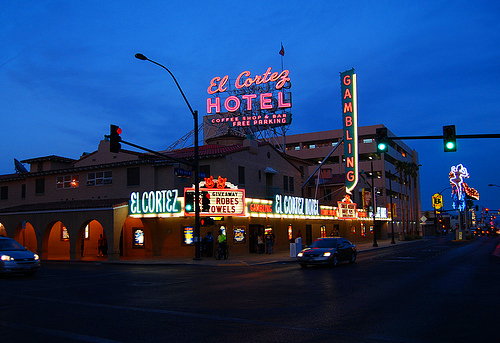
The El Cortez Hotel and Casino Information technology's brick facade dates back to 1941 when Marion Hicks built the small casino with 59 rooms. When Bugsy Siegel finally fabricated that long bulldoze up the highway in the early 1940s, it was not to have a fever dream about building a rug joint on the Strip but to muscle his way into the race wire at the El Cortez. But the Hollywood story sounds meliorate no doubt. Siegel finally got his hands on the El Cortez when Hicks sold the property to him in 1946. Renowned Southern California architect, Wayne McAllister did the remodel on the El Cortez in 1946.
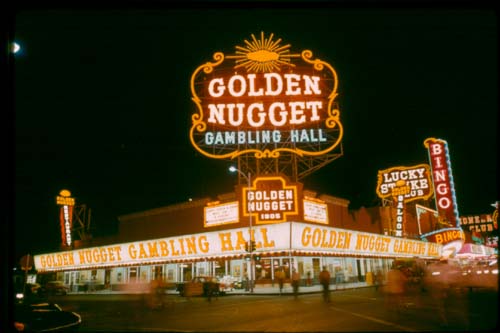
The Golden Nugget sign This is a picture of the Golden Nugget before Hermon Boerngne and Kermit Wayne added the bullnose facade. Different the frontier themed gambling halls on Fremont Street, the Golden Asset sought to evoke the California Gold Rush era of opulent San Francisco. With its filigree Victorian rooftop sign that seemed to float in the dark time heaven 100 feet in a higher place the casino, Boernge captured the flavorand that era using a mixture of neon and incandescent light. The sign became a landmark on Fremont Street. Over the years, the Aureate Nugget became one of the most photographed signs in the world.
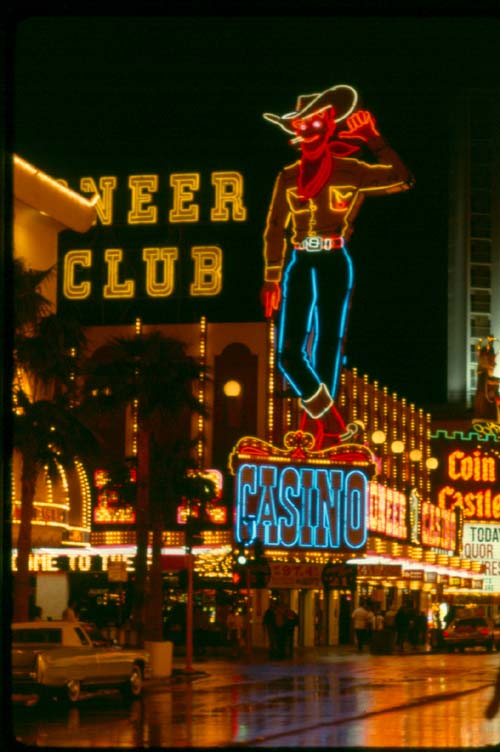
Vegas Vic and the Pioneer Social club In a smart movement in 1951, the Sleeping room of Commerce approached Young Electric Sign Company virtually designing and building a neon cowboy for the Pioneer Club. Vegas Vic was to become the icon of Fremont Street. Myths over the years included having various designers beingness responsible for Vic and many others purported to exist the model. Vic was designed past ane of Yesco'due south Salt Lake City designers, Patrick Denner.
Vic was 75 anxiety alpine, had one moveable arm with a glowing cigarette in 1 paw and the other arm moved back and forth. He had a vox box that proclaimed "Howdy Podner" every xv minutes. Vic stopped talking in 1966 when Lee Marvin and Woody Strode, tired after a mean solar day of working on location in the Valley of Burn down for the film "The Professionals", were kept awake by Vic's friendly greeting. Taking a couple of bows and arrows from the prop department, one night they commenced shooting at Vic from their hotel rooms across the street at the Mint Hotel. City fathers decided that perhaps it was best if Vic stopped talking.
Vic has an older brother of sorts, Wendover Will located fittingly plenty in Wendover, Nevada. He, too, was designed by Patrick Denner.

The Mint The Mint is truly 1 of the casinos on Fremont Street that people nevertheless miss. Built in 1957 with a tall, pink and white pylon sign designed past Yesco's Kermit Wayne and Hermon Boernge, it was an eye-catcher. The white stripe of lights that raced across the front of the sign and then upward to the heavens to light the starburst at the top made the Mint one of the most photographed icons on Fremont Street. Co-ordinate to Alan Hess, the Yesco designers worked with the architects, Zick and Precipitous, on the design of the Mint. The sign was one of the first to exploit the three dimensional sweep of neon on Fremont Street.

Fremont Street, mail service 1955
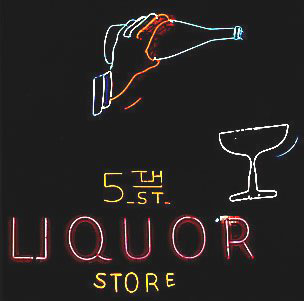
Fifth Street Liquor This neon sign, restored past the Neon Museum and on display, originally graced Las Vegas Boulevard (known to locals as Fifth Street).
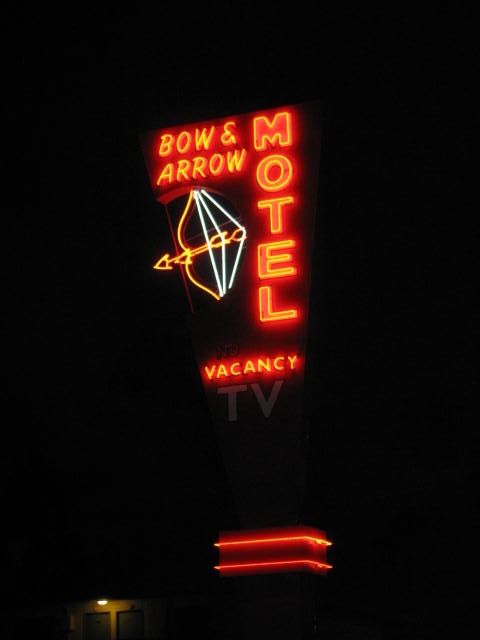
The Bow and Pointer Motel sign Restored past the Neon Museum, this sign is a wonderful example of the many cabin neon signs that used to dot the landscape of Classic Las Vegas.

Hacienda Horse and Passenger This wonderful sign once graced the sign at the Hacienda Hotel on the Fabulous Las Vegas Strip. It now rides loftier and proud over Fremont Street, having been restored by the Neon Museum.
Originally designed by neon designer, Brian "Buzz" Leming. Brian "Buzz" Leming grew up in Henderson and always loved drawing. He became a fireman with the local section before deciding that what he really wanted to do was blueprint neon signs. He mentored under Betty Willis and worked with the legendary Hermon Boergne and Kermit Wayne. His signs include the Lawless Center, the Hacienda Horse and Rider that rides higher up Fremont Street and the Rio sign. He was part of the design squad on the original Aladdin Sign and the original Caesars Palace sign. Buzz retired in 2008 after a long and colorful career.
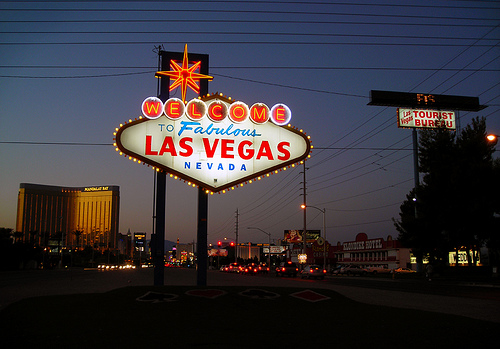
Welcome to Las Vegas sign This iconic sign has been welcoming visitors to Las Vegas for over sixty years. It was designed by Las Vegas native, Betty Willis. Betty Willis was born and raised in Las Vegas. Her family used to travel by train to Los Angeles when she was younger and she fell in beloved with neon signs and their vibrant colors. After studying at the California Fine art Plant in Pasadena and working in the art department/marketing at the old MGM studios, she returned to Las Vegas and began her career equally a Neon Designer in those halycon Classic Las Vegas days. She has designed many of the most iconic signs we acquaintance with Las Vegas: The Welcome to Fabulous Las Vegas sign, the Moulin Rouge and the Blue Angel, just to proper name a few.
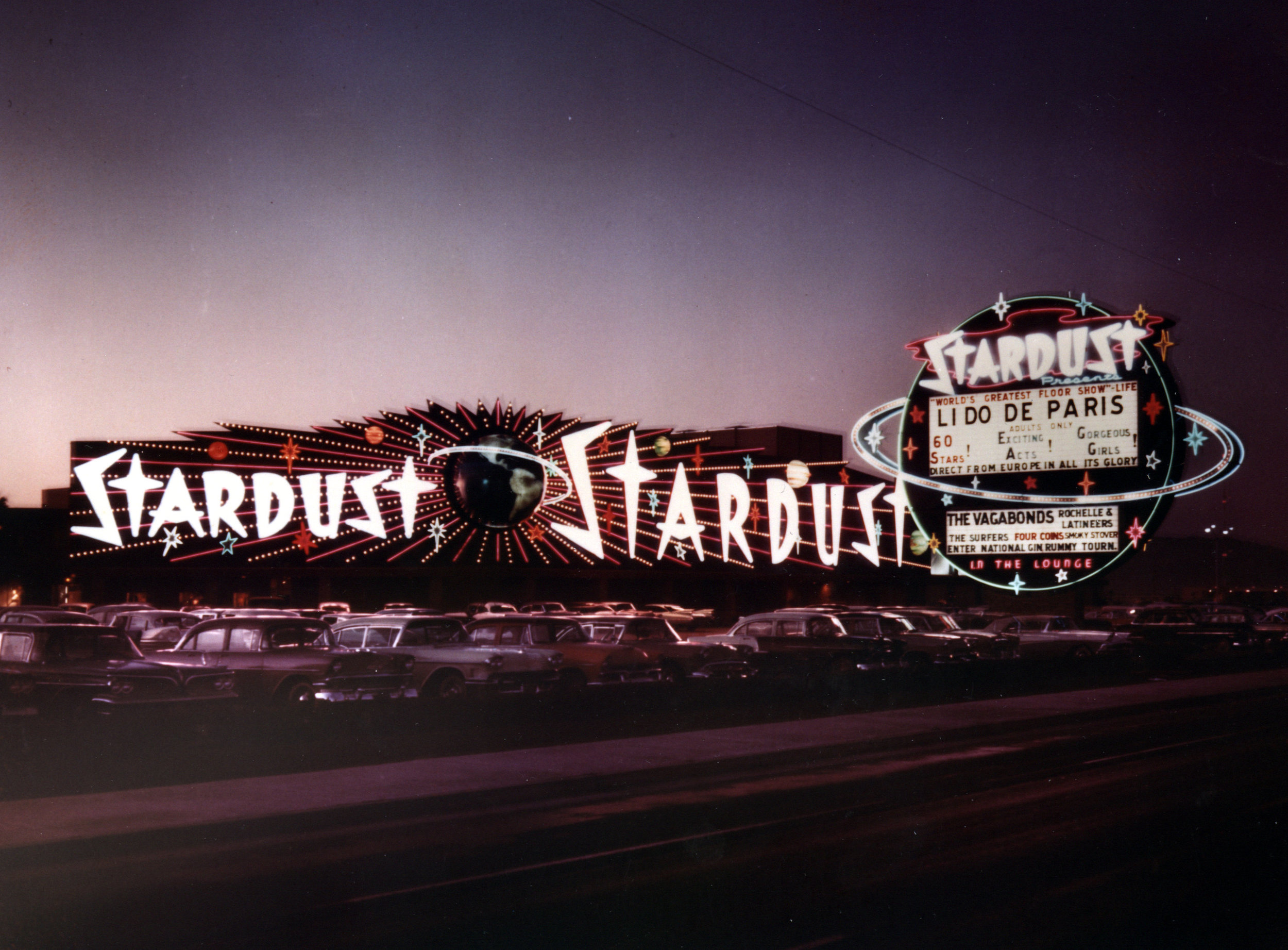
The original Stardust Hotel facade The Stardust Hotel and Casino presently after it opened. Kermit Wayne was i of the senior designers, forth with Hermon Boernge, at YESCO that routinely got tapped for big jobs and this one was no exception. The construction foreman asked YESCO and the other sign companies for ideas. YESCO held a design competition among its top designers.
Kermit Wayne'south galaxy of neon facade and sign were chosen. According to Alan Hess, with so much space so many fragmented elements spread across the huge lot, the facade and sign were crucial to the design. Passing motorists had to be engaged as they approached the resort and the signage had to tempt them off the highway. Considering the Stardust was surrounded by desert, the owners were agape that at night the hotel would be difficult to meet.
Abandoning the Old-West themes and the more sophisticated signage of the other hotels, Wayne went for bankrupt and put the unabridged solar system across the front of the hotel that exploded out towards the edges. At the facade's middle was a large, plastic earth, that co-ordinate to Hess, "was 16 anxiety in bore, formed in slices three feet across and ringed past a Sputnik, which was correct off the front page of the daily papers. Cosmic rays of neon and electric light bulbs pulsed out from behind the globe in all directions."
Three dimensional planets spun into the night alongside twenty neon starbursts. Plastered across this universe, in infinite-age lettering that became iconic, were the letters Stardust. The "S" alone independent 975 lamps. During the day, the heaven's painted sail metal looked deep bluish but on a clear night the neon constellation was said to be visible sixty miles away as motorists made the plough around the mountain into Las Vegas.
Standing on the highway in front of the hotel was a free-standing planet, a circle with a cloud of cosmic dust surrounding an outer ring and covered in stars. The resorts proper noun was emblazed across the acme amid a circle of neon. The marquee lath boasted the Lido de Paris (all the way from France) and the lounge entertainment. Smaller signage marked out the property lines. The roadside sign was no bigger than the Desert Inn's Marquee or the Flamingo's but it took neon signage on the Strip into the stratosphere.
The facade was bent slightly in the heart assuasive the planet globe to jut out. This was to conform with the building. The southern one-half of the sign angled back so information technology could be seen past north-bound traffic.
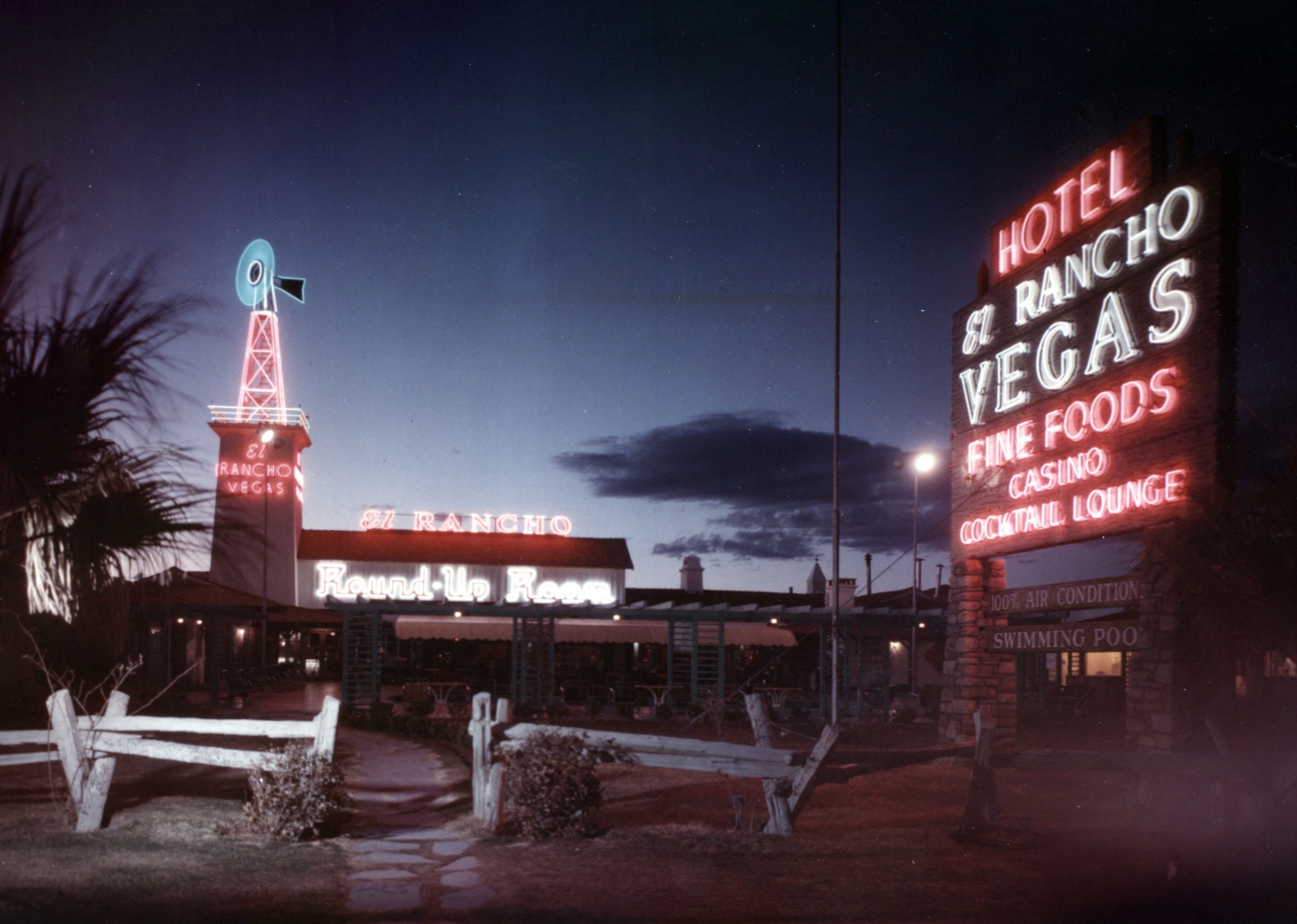
El Rancho Hotel and Casino When Thoma Hull was building the original El Rancho Vegas he hired famed architect Wayne McAllister of the firm McAllister and McAllister. The showtime rendering closely matched the finished complex. The neon-lit windmill atop the main building would become its trademark. In those early days, the neon signage could exist seen for miles. The buildings were all painted white and thegrounds landscaped with dark-green grass, flowers and palm trees.
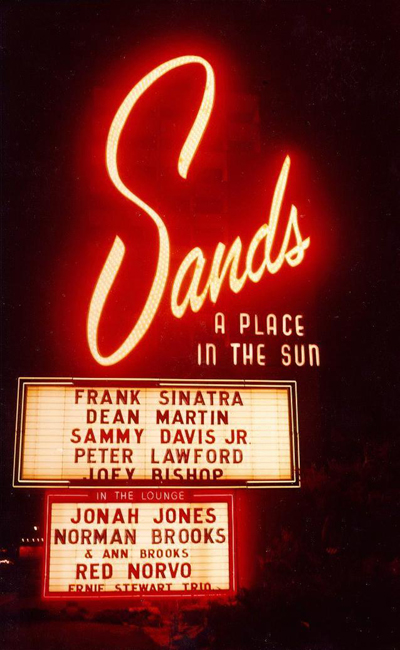
The Sands Hotel and Casino sign The Sands Hotel, probably more any other, came to symbolize the Las Vegas of our commonage memory. The roadside sign was a departure from the usual sail metal and neon displays that beckoned road-weary travelers to finish and stay. McAllister designed a 56-human foot (the S solitary was 36-feet) tall sign, by far the tallest on the highway at that time. With its elegant modern script, the sign composite with the edifice to create a mid-century mod paradise. The sign and the building had motifs common to both. The sign was fabricated by YESCO. With its egg crate grill, cantilevered from a solid pylon, it played with desert light and shadow. In bold free script, it proclaimed "Sands" in neon across the face up. At night, it glowed cherry when the neon spelled out the name.

The Somerset Shopping Eye Not far from the famed Las Vegas Strip on Convention Middle Bulldoze sits a shopping eye that dates dorsum at least 50 years or more than. This wonderful neon sign has anchored the center from the beginning.
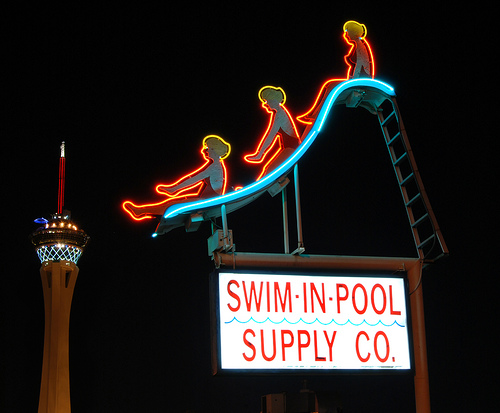
Swim-In-Pool sign This iconic sign, designed by neon designer Betty Willis, has been a favorite of neon-lovers for almost 50 years. information technology had been a staple on Master Street and featured a wonderful animated sequence of a young girl sliding downward into a pool, until it was badly burned in an electrical burn down.
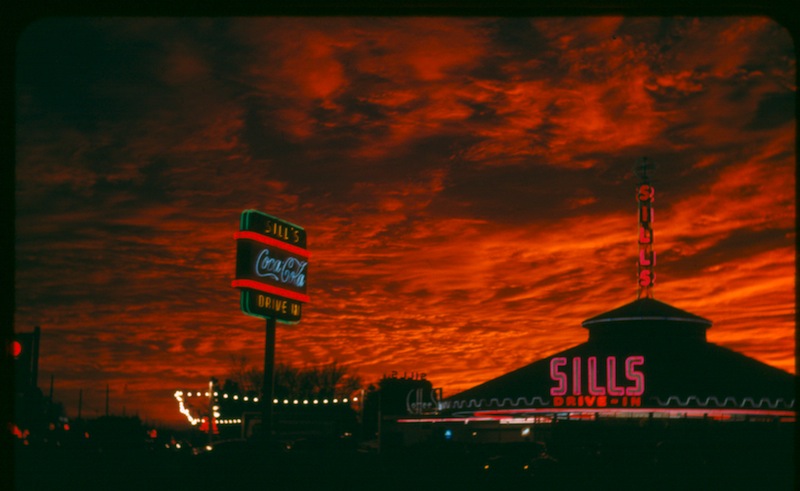
Sill's Drive-In Sill'due south Drive-In located at the corner of Las Vegas Boulevard and Charleston Blvd was i of the premiere loftier school hang-outs back in the days of Archetype Las Vegas. "Adept Nutrient need not exist Expensive" was its motto.
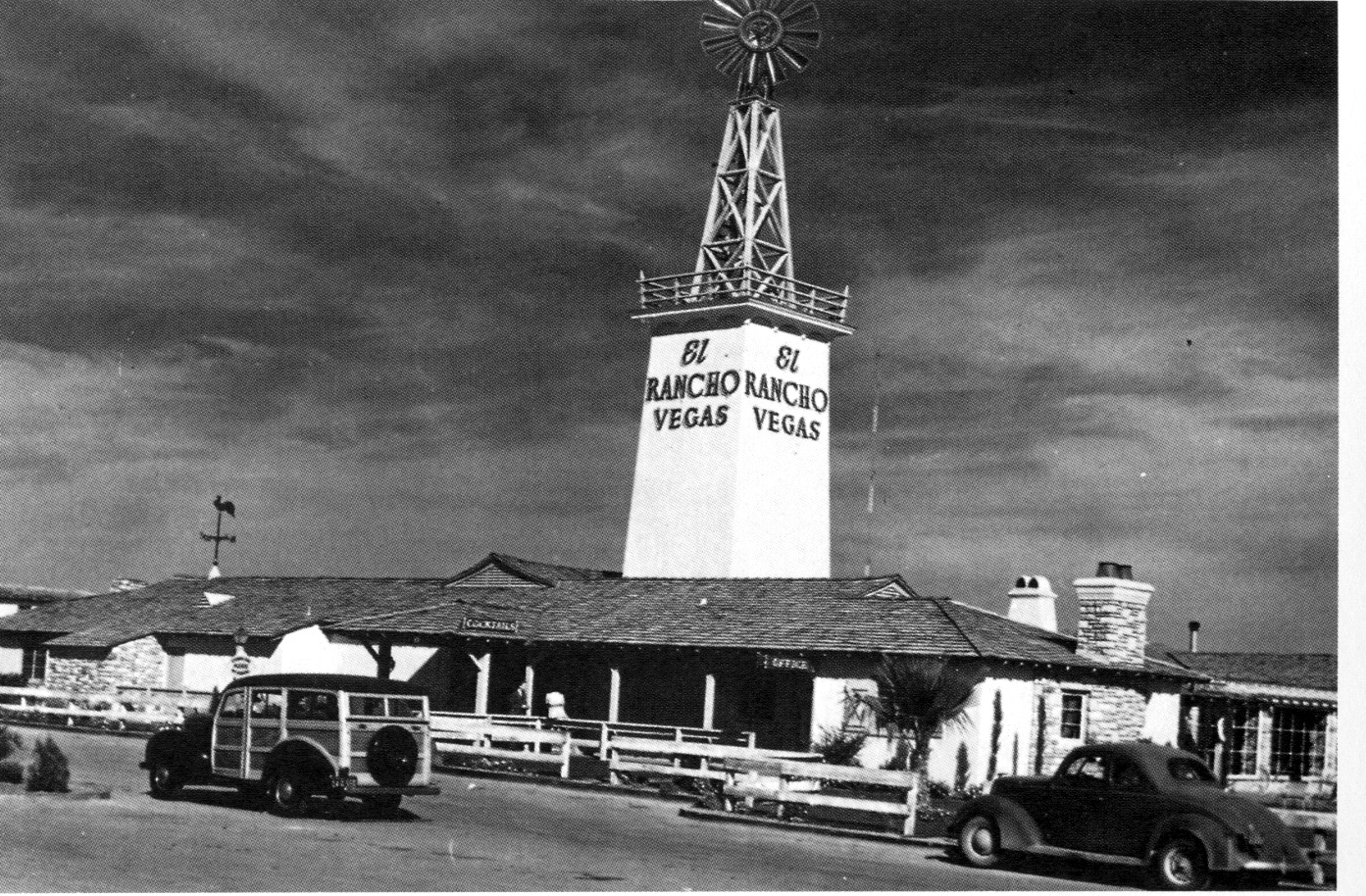
El Rancho Vegas For decades, the story has been that hotelier Tommy Hull's motorcar broke downwardly on the onetime LA Highway (Highway 91) virtually San Francisco Artery (now Sahara Avenue). It was a hot day with the sun chirapsia down. While waiting for a tow truck, Hull counted the cars that drove by and envisioned a swimming pool that fronted on the highway and would invite weary, sweaty travelers to stop at his hotel. It'south a good story but information technology's a myth.
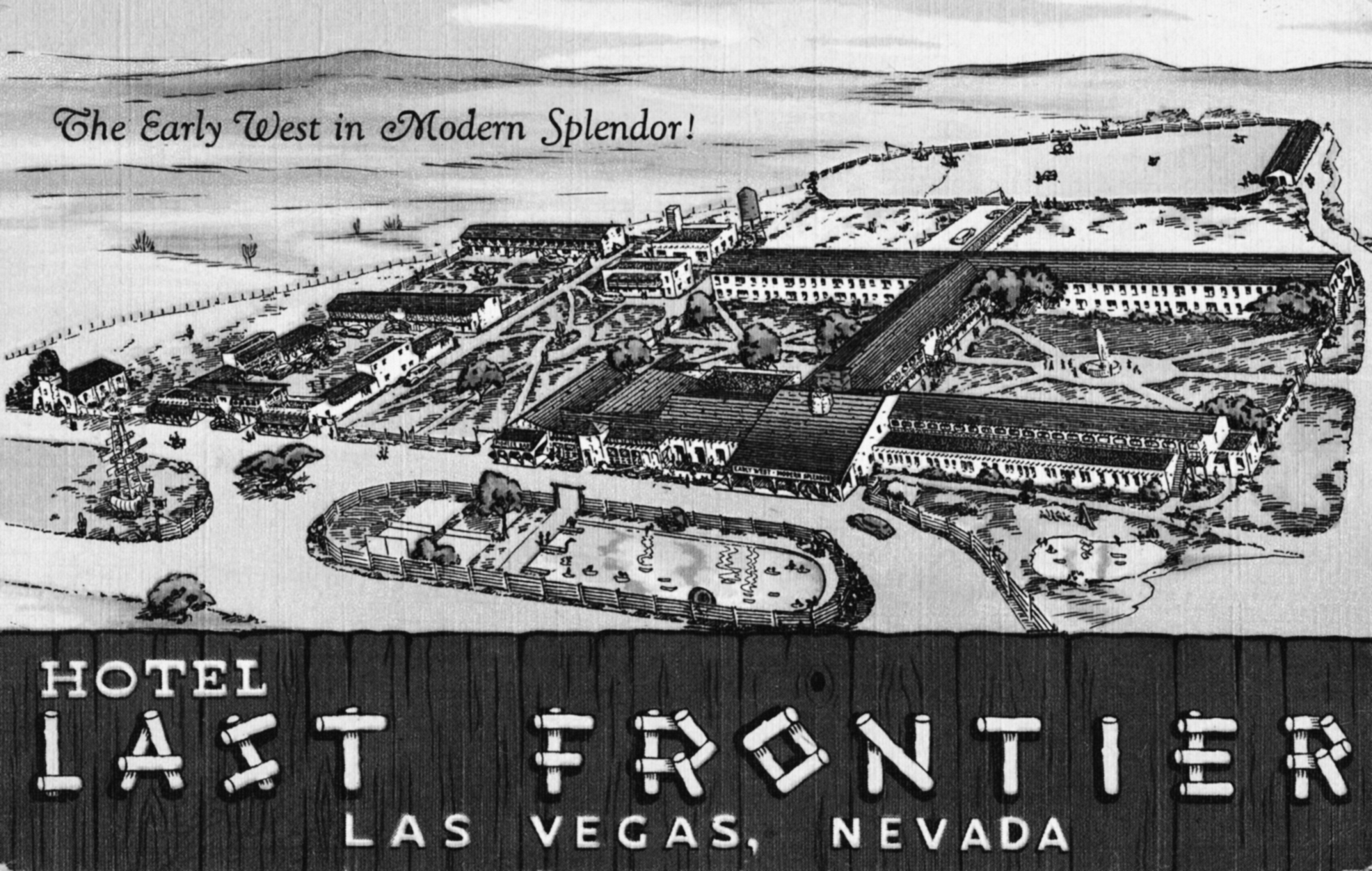
Hotel Last Borderland In 1941, theater magnate R.E. Griffith and his nephew, architect William J. Moore, were passing through Las Vegas on their way to California to purchase building materials for a resort they were planning in Deming, New Mexico. They saw the El Rancho Vegas under construction. Tommy Hull's resort hotel was rising alone on the dusty highway except for a few bars and saloons. Griffith and Moore thought there was room for at to the lowest degree one more resort. "We came to Las Vegas and constitute that the opportunities were fabled." Moore recounted in his oral history.
They scraped their plans for the resort in Deming and decided to build on holding merely south of the El Rancho Vegas. They figured if they built south of the El Rancho Vegas, travelers on the Los Angeles Highway would see their resort offset and exist tempted to pull in to their resort instead of the El Rancho Vegas. They tracked downwards Guy McAfee, the possessor of the property and for $35,000 bought 35 acres of highway-fronted property. McAfee was overjoyed to accept sold the state for so much money, thinking he had suckered a couple of rubes into overpaying for the property. Moore and his colleague, Jack Corgan, did the final drawings for the resort in a hotel room in Dallas.
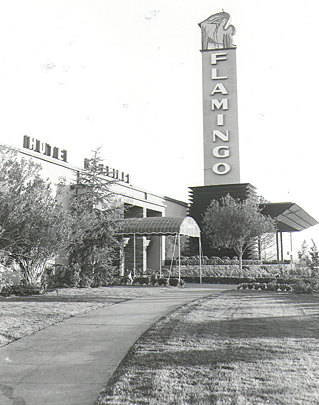
The Fabled Flamingo Hotel By now we all know the myth. Benjamin Siegel, looking a groovy deal like Warren Beatty, drives up a dusty highway into Downtown Las Vegas. Not liking the dust, the crowd or the frontier architecture, he takes a ride back out of town. He stops off the dusty, empty highway and has a fever dream. He announces to Virginia Hill, looking a nifty deal like Annette Bening, that here is where he will build the world's greatest hotel, The Fabulous Flamingo. It'southward a pivotal moment in the moving-picture show "Bugsy" but the reality is that information technology is a myth.
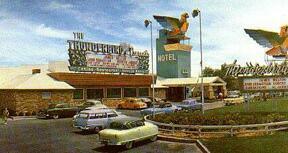
The Thunderbird Hotel The Thunderbird began life every bit a dream shared by two good friends, local attorney Cliff Jones and full general contractor, Marion Hicks. In 1946, they had bid on a Reno hotel in hopes of getting in the gaming business. Unfortunately, they were outbid. They returned to Las Vegas still adamant to become resort owners. On the trip home they discussed their possibilities and both agreed that edifice a hotel on the LA Highway (Highway 91) would be the best idea. There were already two hotels, the El Rancho Vegas and the Hotel Final Frontier that were doing adept business concern. The Fabled Flamingo was aggress with building delays due to shortages created by the just ended War.
Deciding to wait until edifice supplies were more than easily attainable, they set out to observe the right piece of holding. The state they wanted was owned by Guy McAfee, then owner of the Golden Asset on Fremont Street. The three men negotiated a bargain (and wouldn't you have wanted to be a wing on the wall listening to that!) The property fronted on 1,100 anxiety of the Highway. They also bought a piece of state along Paradise Road.
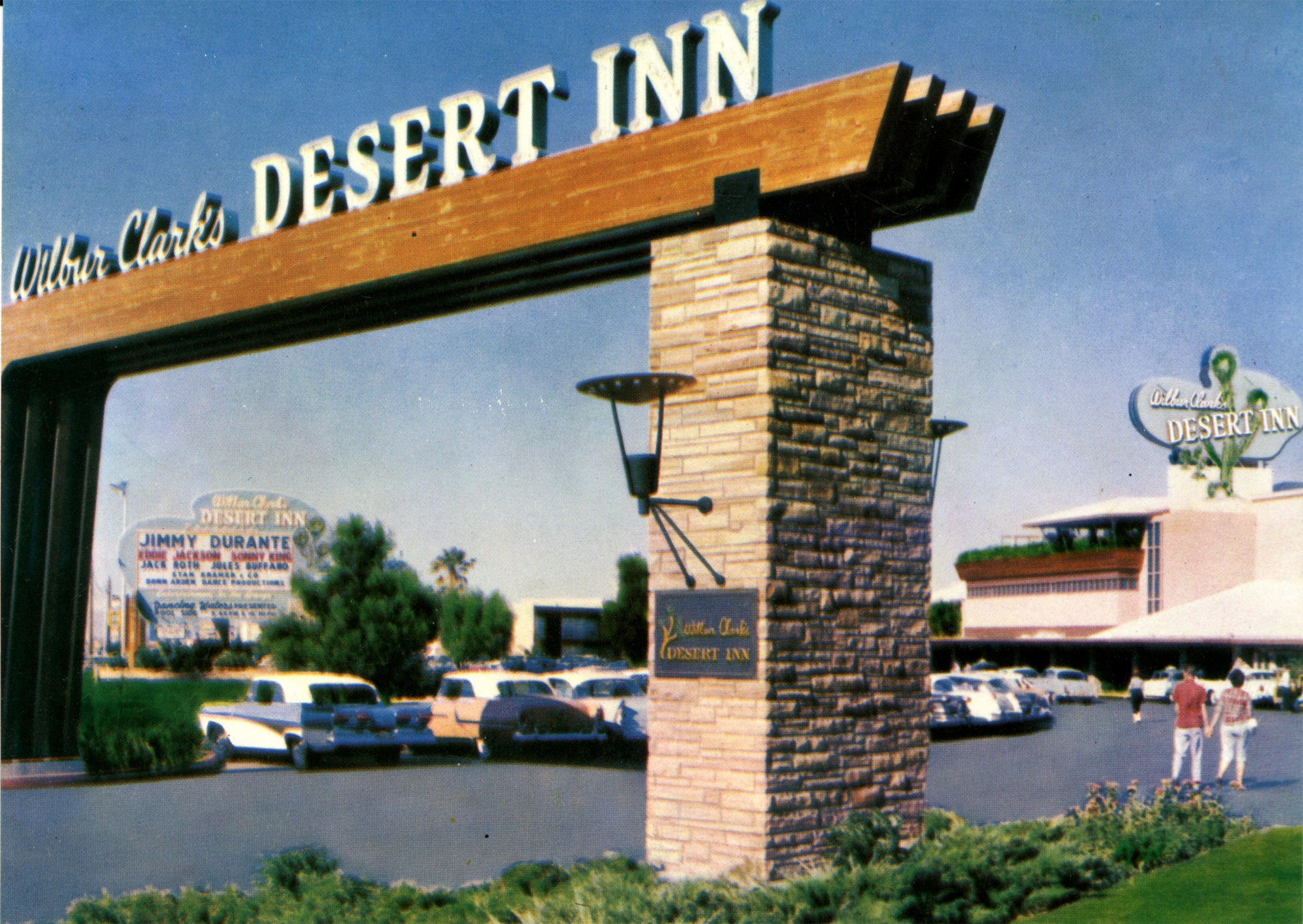
Wilbur Clark'south Desert Inn Archway The commencement hotels on the Las Vegas Strip were known by their names, El Rancho Vegas, the Hotel Final Frontier, etc. A visionary with a sense of early branding decided that his new hotel would be more and thus, Wilbur Clark's Desert Inn was born and would become earth famous, even long later on Clark himself had shuffled off this mortal curlicue.
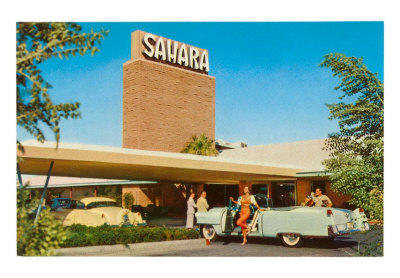
The Sahara Hotel Fred Schivo was a long-fourth dimension gamer who had the idea for the Guild Bingo, a 300-seat bingo parlor. He had to find investors that would be willing to accept the fiscal plunge. He lucked out when he met Milton Prell from Butte, Montana. Prell had operated the "30 Order" in Butte but similar many other gambling visionaries of the day he relocated to the friendly climes of Las Vegas in the 1940s. Though not also known today equally others such as Wilbur Clark and Del Webb, Prell however, made an touch on on Las Vegas.
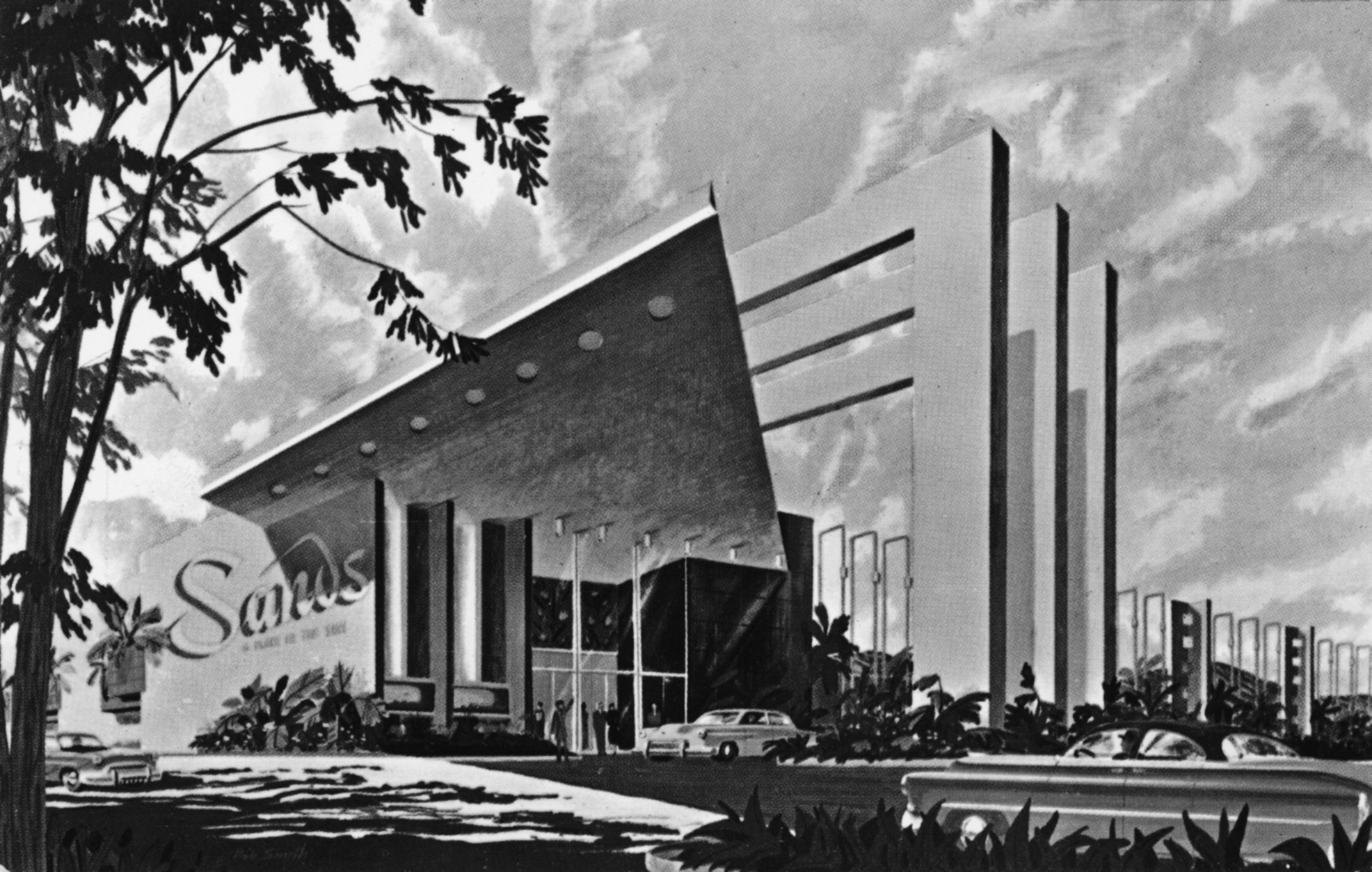
The Sands Hotel The Sands Hotel, probably more than whatsoever other, came to symbolize the Las Vegas of our collective retention. Information technology was hither that the colour line was finally broken, information technology was here that Sinatra, Martin, Davis and the rest of the Rat Pack held court in the Copa Room and were the hottest tickets in town, it was here that Jack Kennedy visited during a campaign trip through Southern Nevada. It was where glamour and glitz met in the Desert and it helped propel tourism in the small desert mecca like no other.
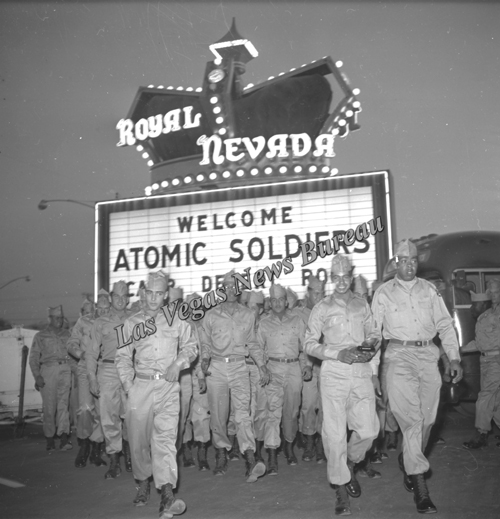
The Royal Nevada Hotel 1955 was a big year for the Strip. Three major hotels would open throughout the year and there was talk that the Strip was being over built and and would not exist able to sustain itself with the number of tourists visiting. What is that old adage, if you build it they will come? Well, that worked for the other ii hotels that opened that year, the Riviera and the Dunes but the Purple Nevada seemed jinxed near from the starting time.
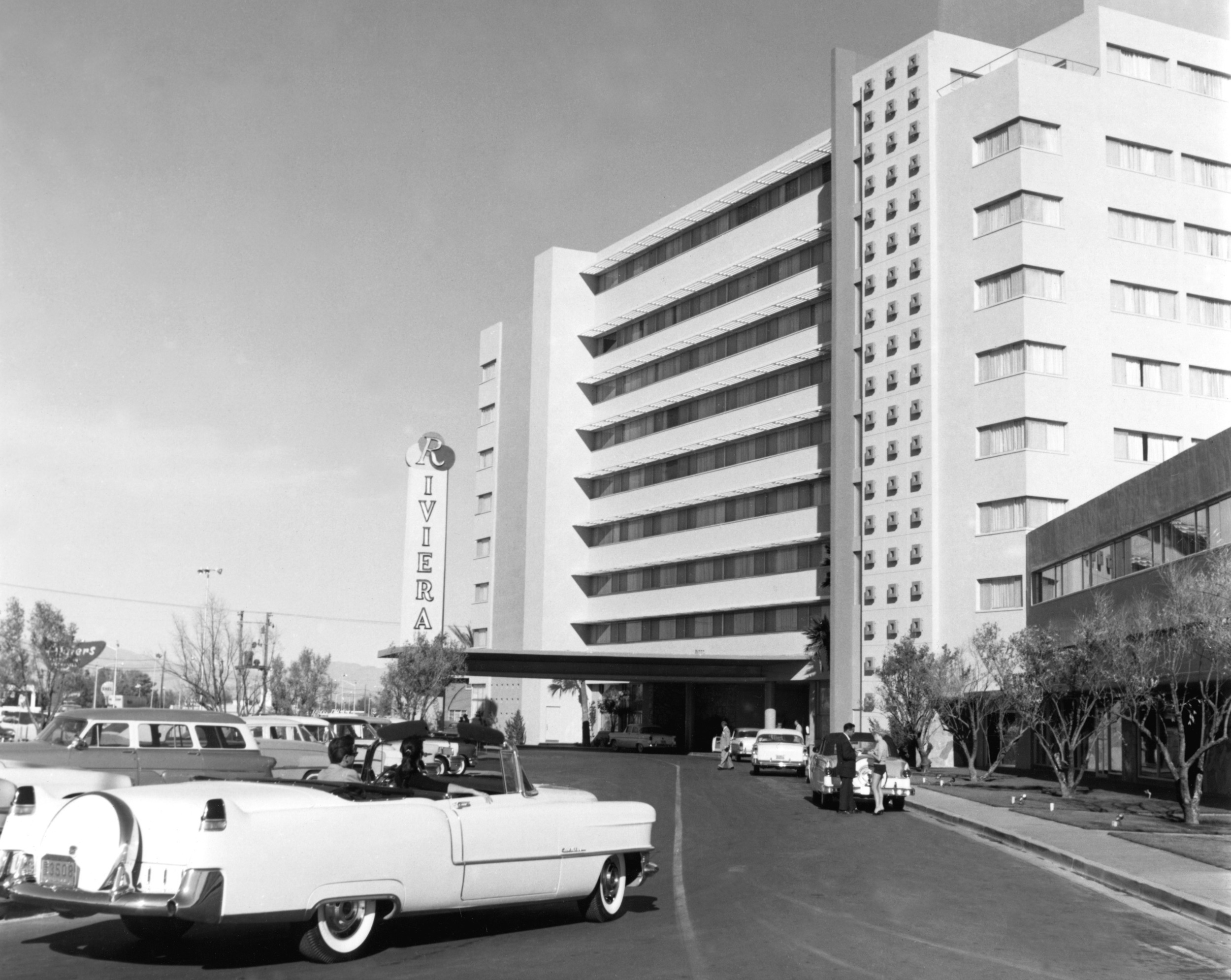
The Riviera Hotel The Riviera created a stir before her doors ever opened. The hotel was to be a deviation from the low-rise, two story garden style motel rooms that had been popular since the early days of the 1940s. The Riviera was going vertical, nine stories into the air, the first high-rise on the famed boulevard. With a price tag of $10 one thousand thousand, the hotel would accept 291 rooms. According to Alan Hess, there was some question around town as to whether the desert soil would even support such a construction.
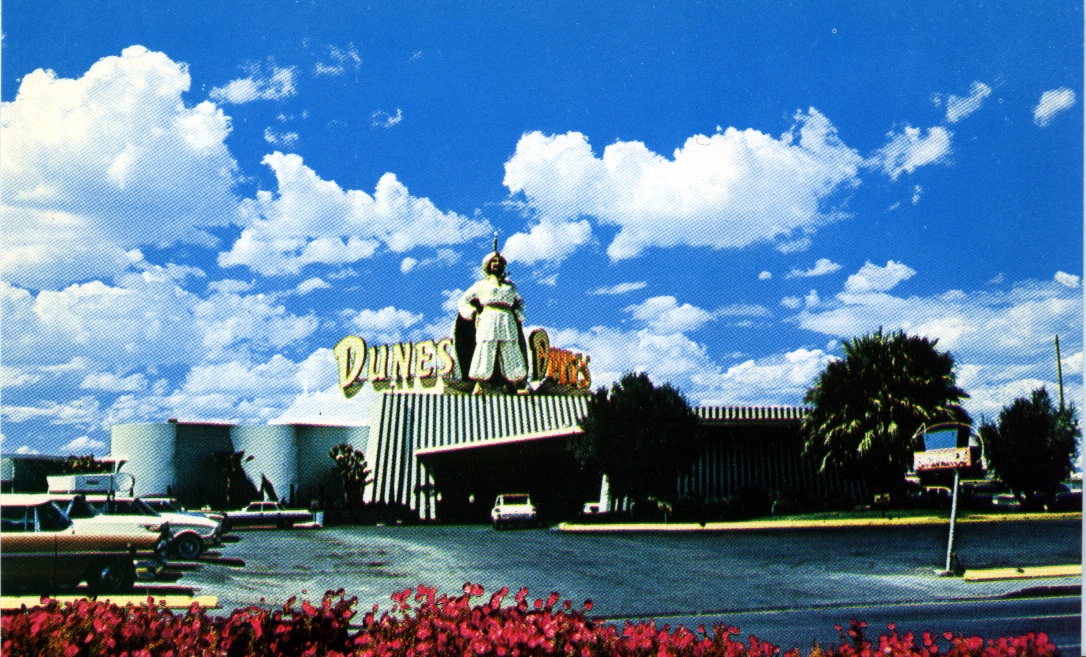
The Dunes Hotel original facade In the winter of 1954, it was announced that plans were moving forrad on the building of a new hotel to be chosen The Dunes. The cost - $5 million. There were 3 major investors listed a restauranteur from Providence, Rhode Island, Joseph Sullivan, Coral Gables, Florida old theater magnet, Alfred Gottsman and Bob Rice who had made his fortune as a costume jeweler in Beverly Hills. They all had ane affair in common: no gaming experience.
It was afterwards believed that the coin that Sullivan had invested actually came from Ray Patriarca, the head of a Rhode Island criminal offence family, in render for reaping the under-the-tabular array profits that would be fabricated from his undisclosed participation.
To larn more, bank check out our new books Gambling on a Dream: The Classic Las Vegas Strip.Volume ane traces the fabulous history of the first hotels built from 1930-1955. Volume 2 continues the story, focusing on the turbulent years of cultural and societal change, 1956-1973.
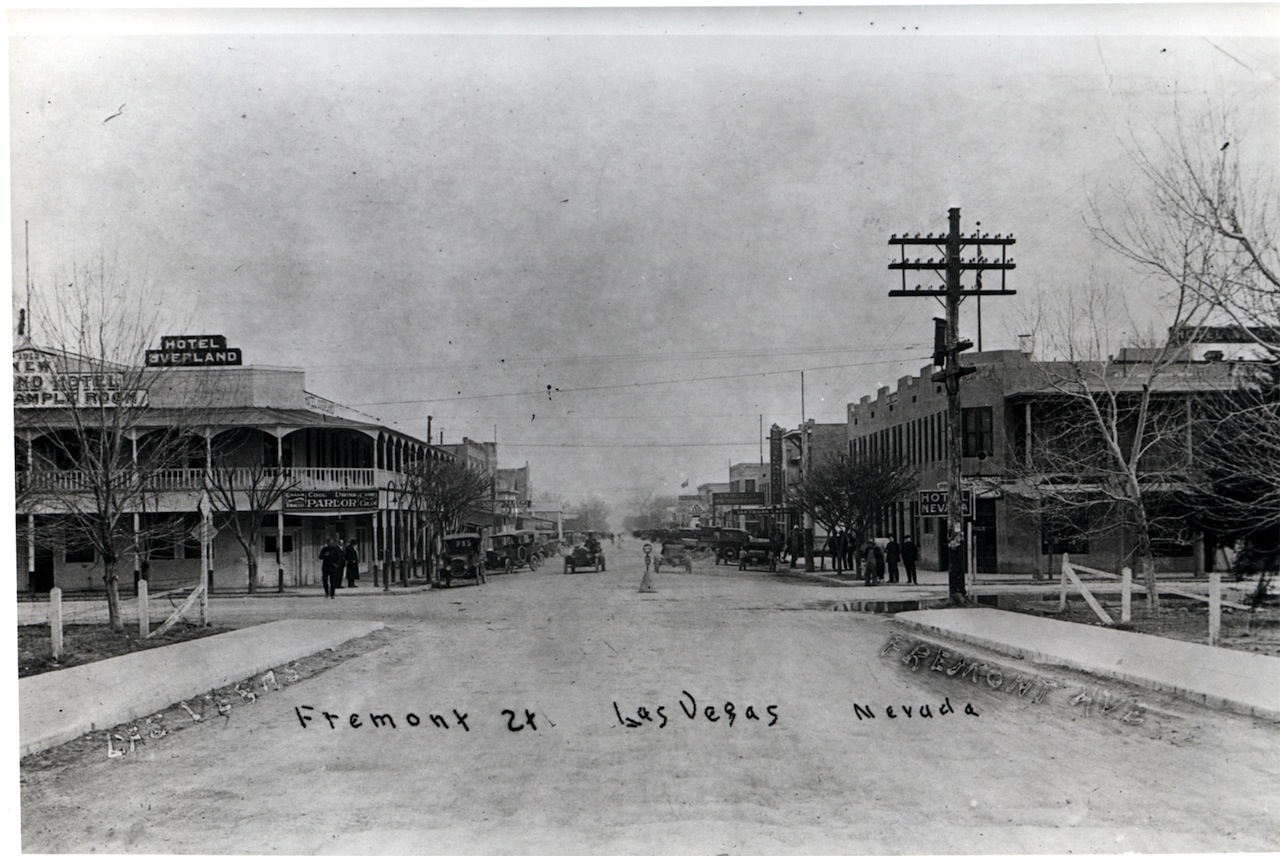
Fremont Street 1906 This is a postcard of Fremont Street in 1906. The land auction that gave birth to Las Vegas was conducted the previous year, 1905. In the foreground are the Overland Hotel and the Hotel Nevada. Today, the Overland Hotel is the Las Vegas Club and the Hotel Nevada is dwelling to the Golden Gate.
Subscribe to our Fremont Street History Web log
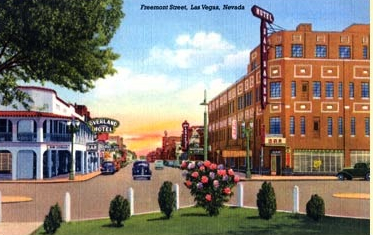
Fremont Street in the 1930s That's the park that used to be in front of the Railroad train Dept in the foreground of the postcard. On the left side of the street is the Overland Hotel and across the street is the Sal Sagev (Las Vegas spelled backward). Today the Overland Hotel is home to the Las Vegas Club and the Sal Sagev is home to the Golden Gate.
Subscribe to our Fremont Street History Blog
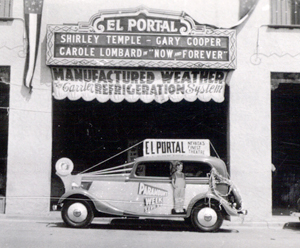
The El Portal Theater The El Portal Theater, owned past insurance man (and mayor) Ernie Cragin, was the commencement theater in Las Vegas to offering ac. Information technology was also segregated, with people of color made to sit in the balcony.
Subscribe to our Fremont Street History Blog
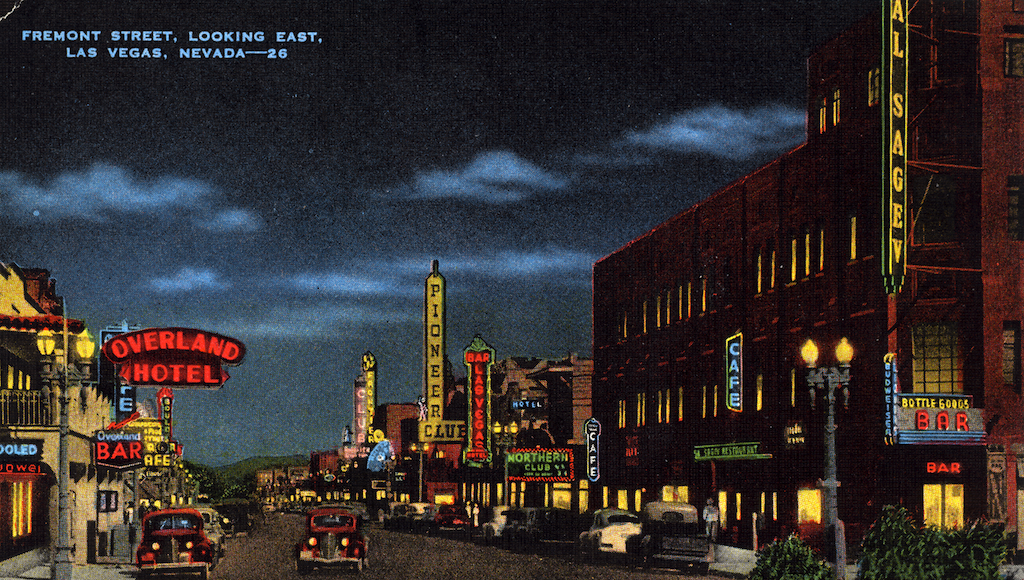
Fremont Street in the late 1930s Thomas Young of the Young Electric Sign has been through town and talked a few businesses into purchasing neon signs!
Subscribe to our Fremont Street History Blog
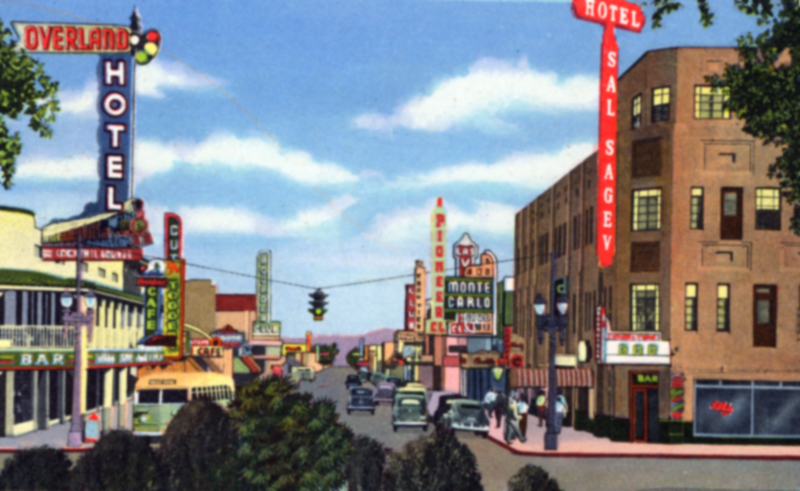
Fremont Street 1940s Looking east from the Railroad train Depot down Fremont Street, with the Overland Hotel on the left and the Sal Sagev Hotel on the right.
Subscribe to our Fremont Street History Blog

Fremont Street in the early 1940s The Hotel Apache is in the foreground just this gives a good idea of the diverse local businesses that catered to the locals. At that place were no shopping malls, in that location was Fremont Street.
Subscribe to our Fremont Street History Web log
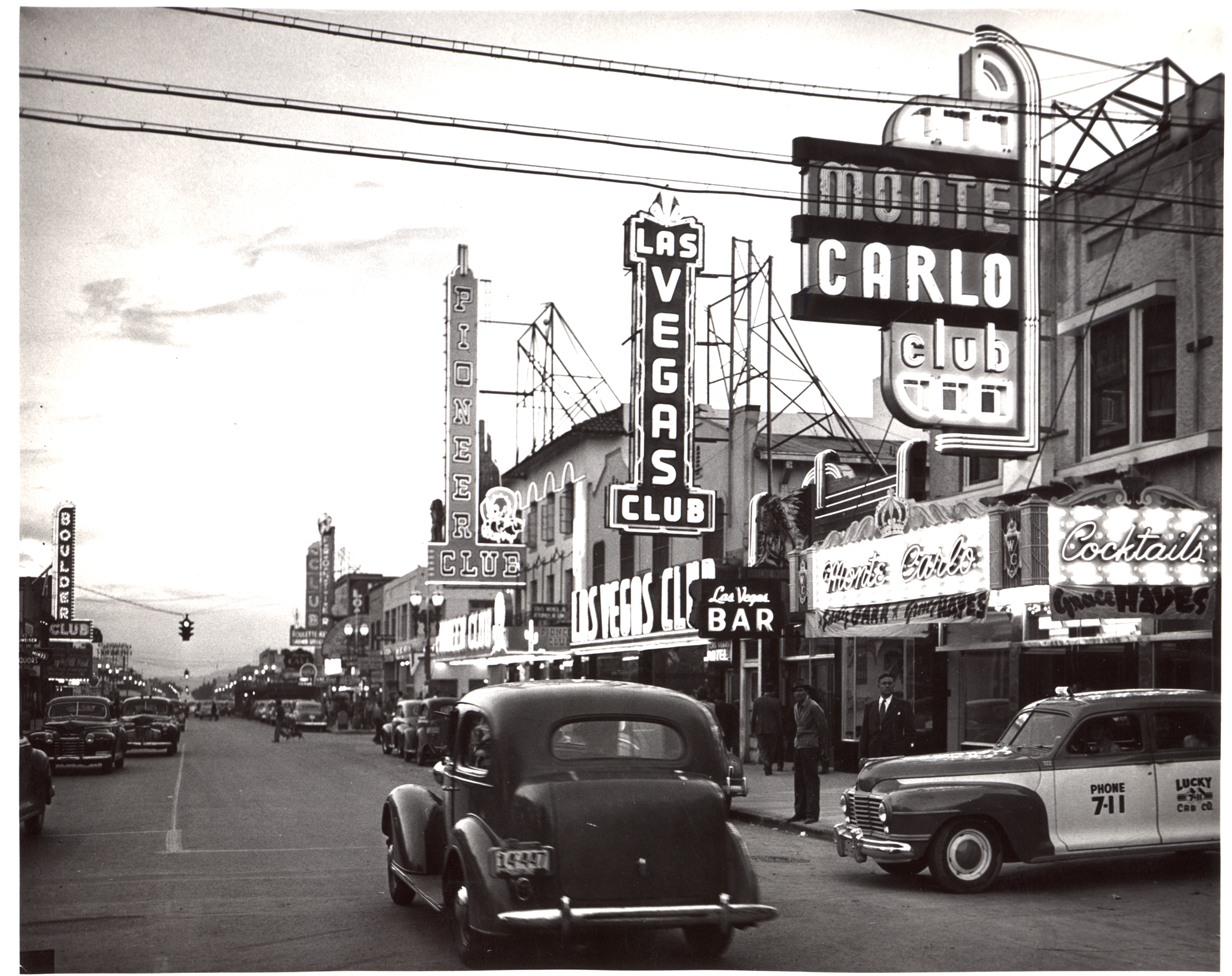
Fremont Street in the mid-1940s The Las Vegas Club has yet to move across the street to the basis floor of the Overland Hotel. The Monte Carlo Club doesn't sport Wilbur Clark's moniker and Vegas Vic has even so to debut.
Subscribe to our Fremont Street History Blog
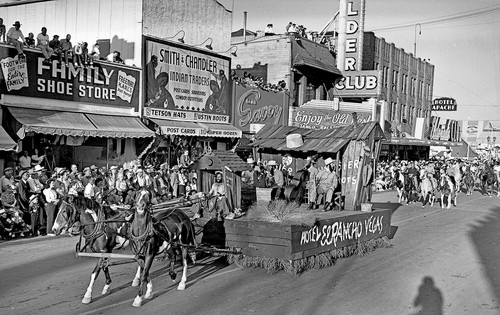
Fremont Street and Helldorado The Helldorado celebration began in the belatedly 1930s. This parade is from the 1940s with the El Rancho Vegas sponsoring a float.
Subscribe to our Fremont Street History Blog
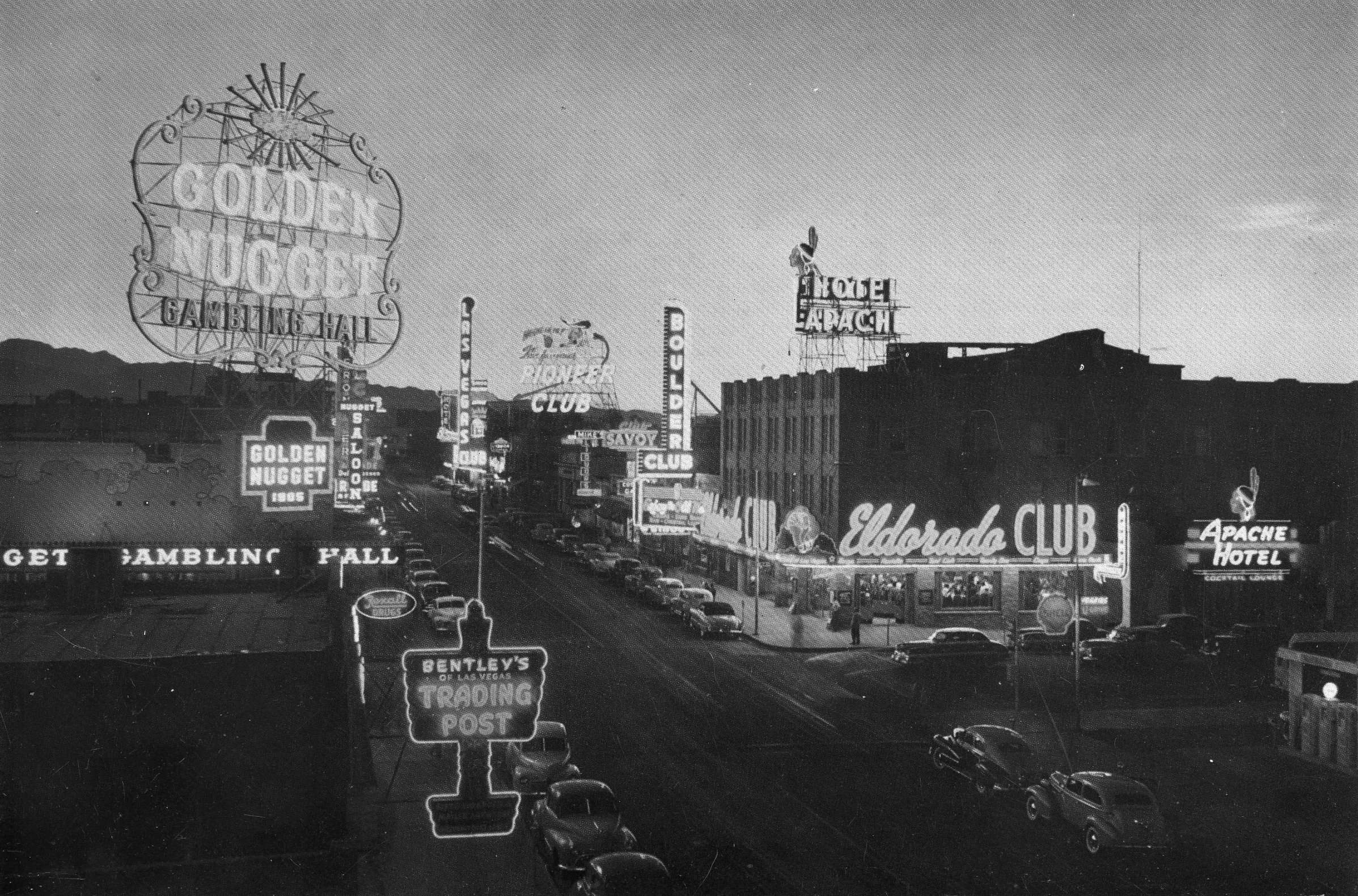
Fremont Street in the tardily 1940s The Golden Asset is sporting it's Victoria-era filigree sign but the Kermit Wayne'Hermon Boernge bull-olfactory organ has withal to be added. Vegas Vic has yet to debut. The El Dorado Order is owned by Kell Houssels, Sr and only waiting for Benny Binion to come to boondocks. Upstairs from the El Dorado Club is the Hotel Apache.
Subscribe to our Fremont Street History Web log
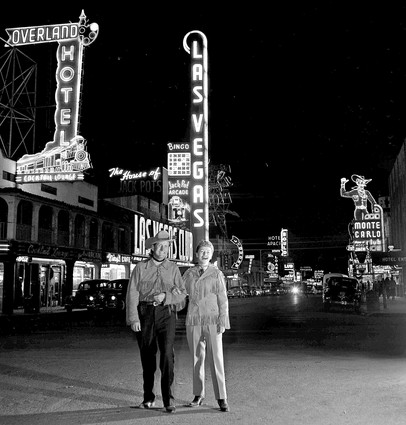
Fremont Street in the 1950s Elmo Ellsworth and Dee Dee Lees stand up on Fremont Street. Behind them is the Overland Hotel neon sign, the Las Vegas Club neon sign. On the correct side of the street is a neon sign for Wilbur Clark's Monte Carlo Club and Vegas Vic's head can be viewed correct backside the Monte Carlo Social club sign.
Subscribe to our Fremont Street History Blog
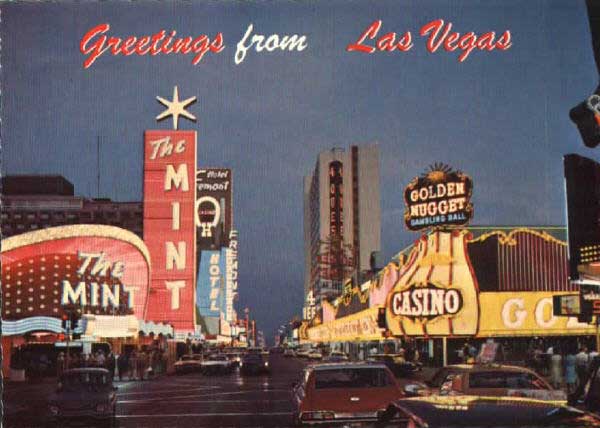
Fremont Street Fremont Street when it was known as Glitter Gulch. A canyon of neon enveloped you every bit you drove down Fremont Street. The neon atop Mint, the Golden Nugget, Benny Binion'south Horseshoe Guild all contributed to the magnificent skyscape.
Subscribe to our Fremont Street History Blog
Trader Bill'due south on Fremont Street Many a Helldorado cowboy got his fancy duds at Trader Bill's and many a cowgirl got her silver and turquoise jewelry hither.
Subscribe to our Fremont Street History Blog

Pete Findlay One of coolest auto dealership buildings e'er to grace the Las Vegas Valley. Located on Boulder Valley, this mid-century mod building looked as if it could take flight.
Photo courtesy of Alan Sandquist

Sears at the Boulevard Mall Sears has been the north end ballast of the Boulevard Mall since the Mall outset opened dorsum in 1966. This photo shows yous what the edifice looked like back and then. The newspaper plate entrance was however at that place in 2010.
Photograph courtesy of the Nevada State Museum, Las Vegas

The original Convention Center It sat back from Paradise Road like a recently landed flying saucer. At dark, it was rimmed in a dark-green neon glow that gave information technology an other-worldly feel. Cassius Clay beat Floyd Patterson hither, the Beatles played here in 1964 and the Doors in 1968. Martin Luther King gave a spoken communication here and Mahalia Jackson a concert, countless loftier school students graduated from here. Across the street was the Landmark Hotel, modeled after the Seattle Space Needle, giving this part of Archetype Las Vegas a definite mid-century look and feel.
Photograph courtesy of the Nevada Land Museum, Las Vegas

Cinerama Dome It was located on Viking just downward Paradise Route from the Convention Center, the Landmark and the Diplomat Apartments. Not every city had a Cinerama Dome (Los Angeles and Seattle come to mind) merely Las Vegas was i that did.
A great place to run across movies, my mom took me to see "Gone With the Wind" (roadshow version) there in 1967. My friends and I saw many a film there in the early 1970s including The Iii Musketeers and The Hindenburg.

McCarran Airport's Delta final at night Designed by Los Angeles architect Welton Becket, the Delta Terminal at McCarran Airdrome even so stands but today, y'all tin't get a view of it like this one.
Photograph courtesy of Nevada State Museum, Las Vegas

McCarran Airport at night Next fourth dimension you go to McCarran, endeavor to imagine that it in one case looked like this - only about 40 years agone!
Photograph courtesy of the Nevada State Museum, Las Vegas
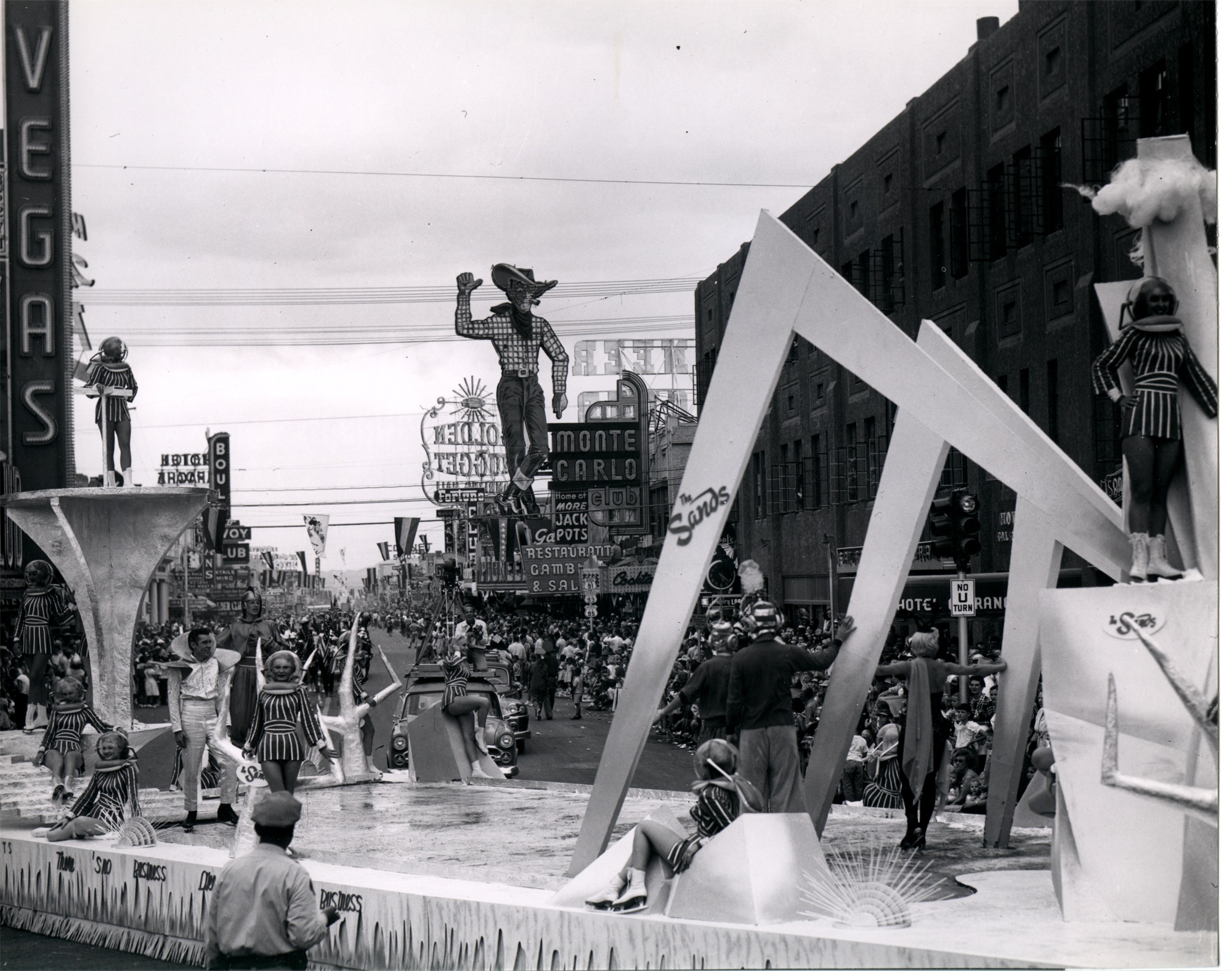
Sands Float for Helldorado The Sands Hotel, possibly the most iconic hotel of the Archetype Las Vegas era, sponsored this improvident float in the Helldorado parade in the 1950s. This is 1 reason why the quondam Helldorado parade once rivaled the Tournament of Roses parade in Pasadena.
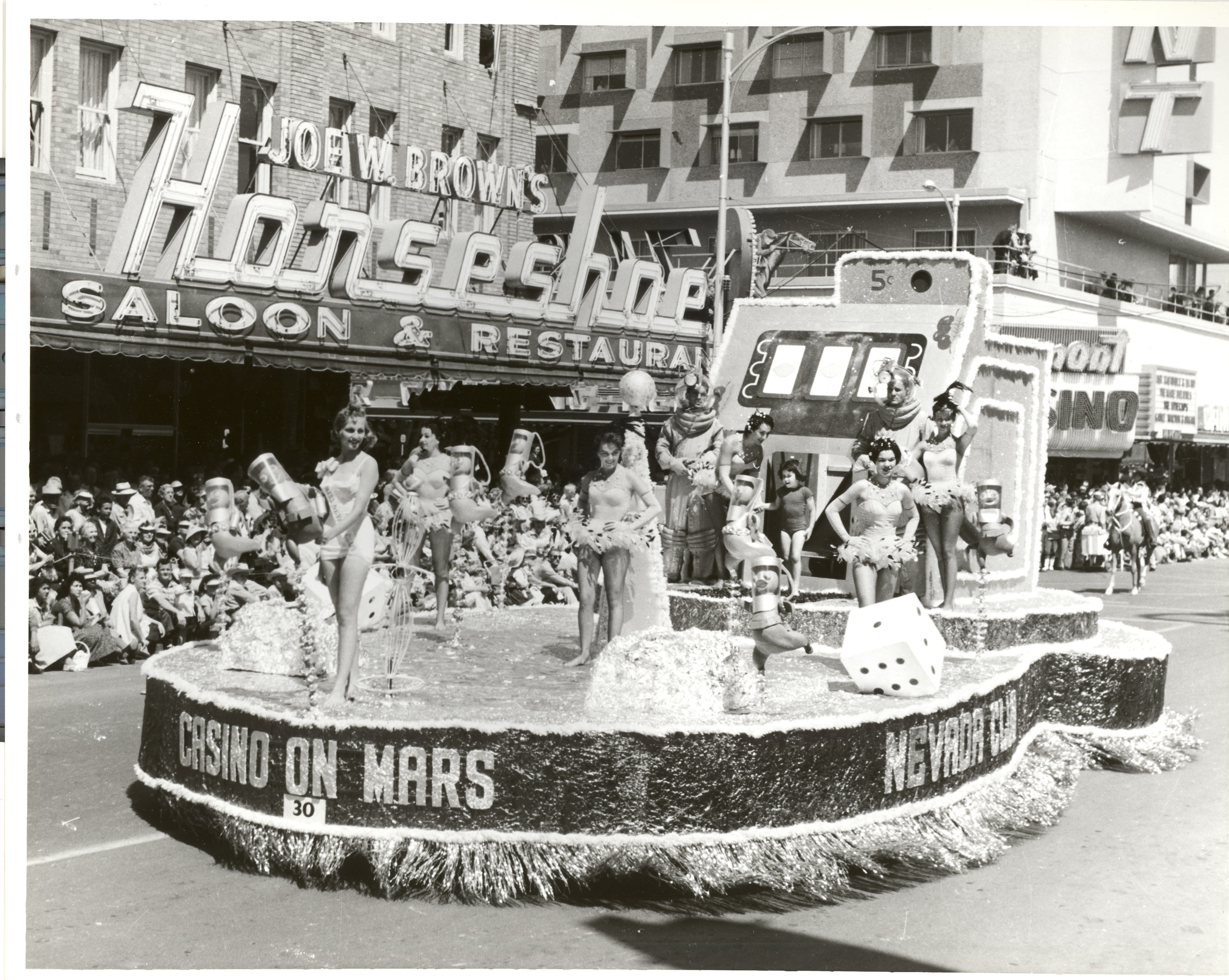
Casino on Mars Bladder Helldorado Parade 1950s Detect that the Horseshoe has Joe West. Brown's name on the facade. This Helldorado parade was held while Benny Binion, the original owner of the Shoe, was "at college", a local way of describing Binion'south stay in federal prison for problems with his taxes. During Benny's stay "at college", the casino was run by Joe Due west. Brown, who put his name on the facade.
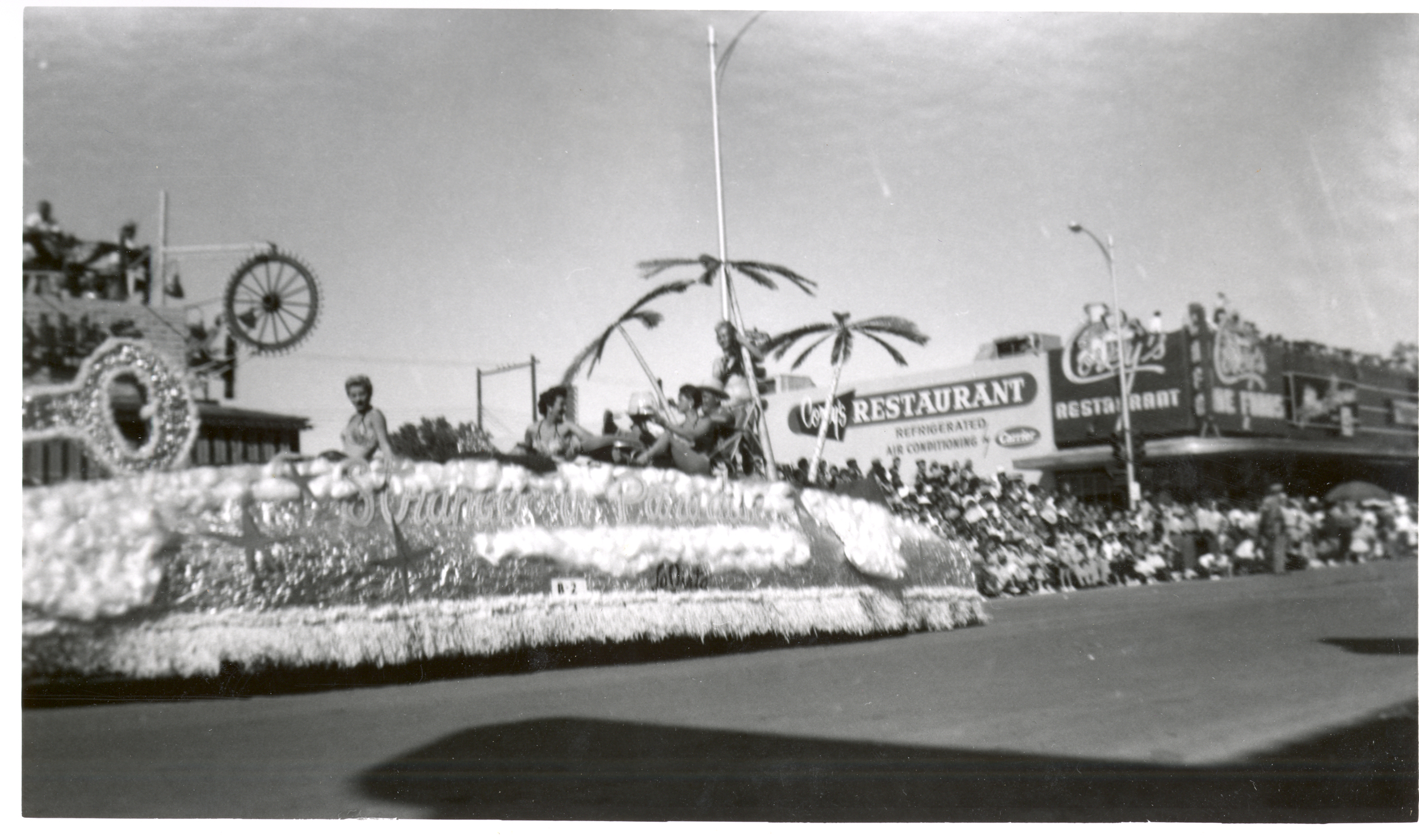
Float in front of Corey's Restaurant This is the "Strangers in Paradise" float on Fremont Street in the 1950s. That'southward Corey'due south Eating place, one of the locals best loved restaurants, in the background.
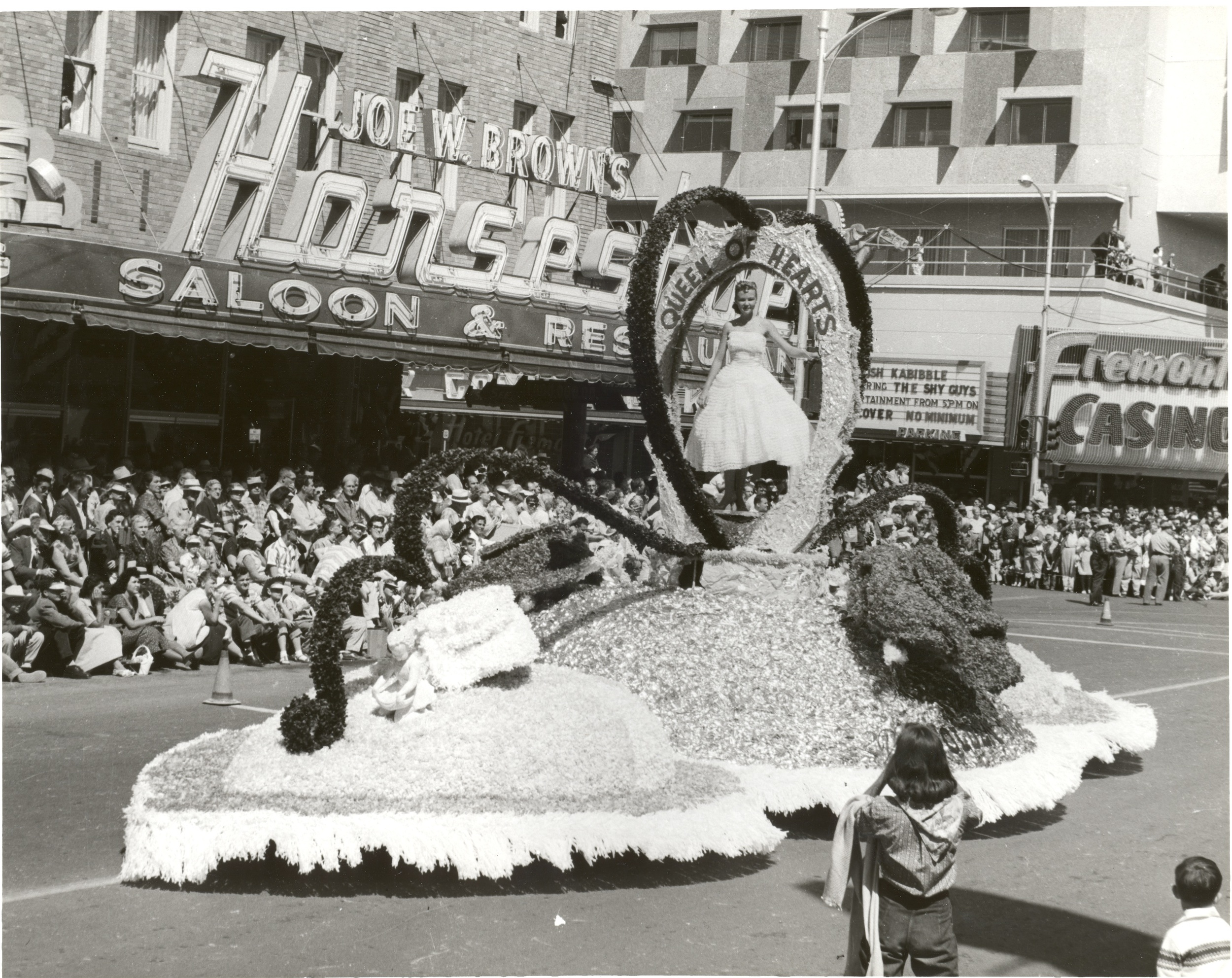
Queen of Hearts bladder In the mid-1950s, information technology looks like the Gold Asset may have sponsored this "Queen of Hearts" float for the annual Helldorado parade.

Children in Helldorado parade Even the immature kids (this is a Scottish Children's group according to the caption) got to participate in the Helldorado parades!
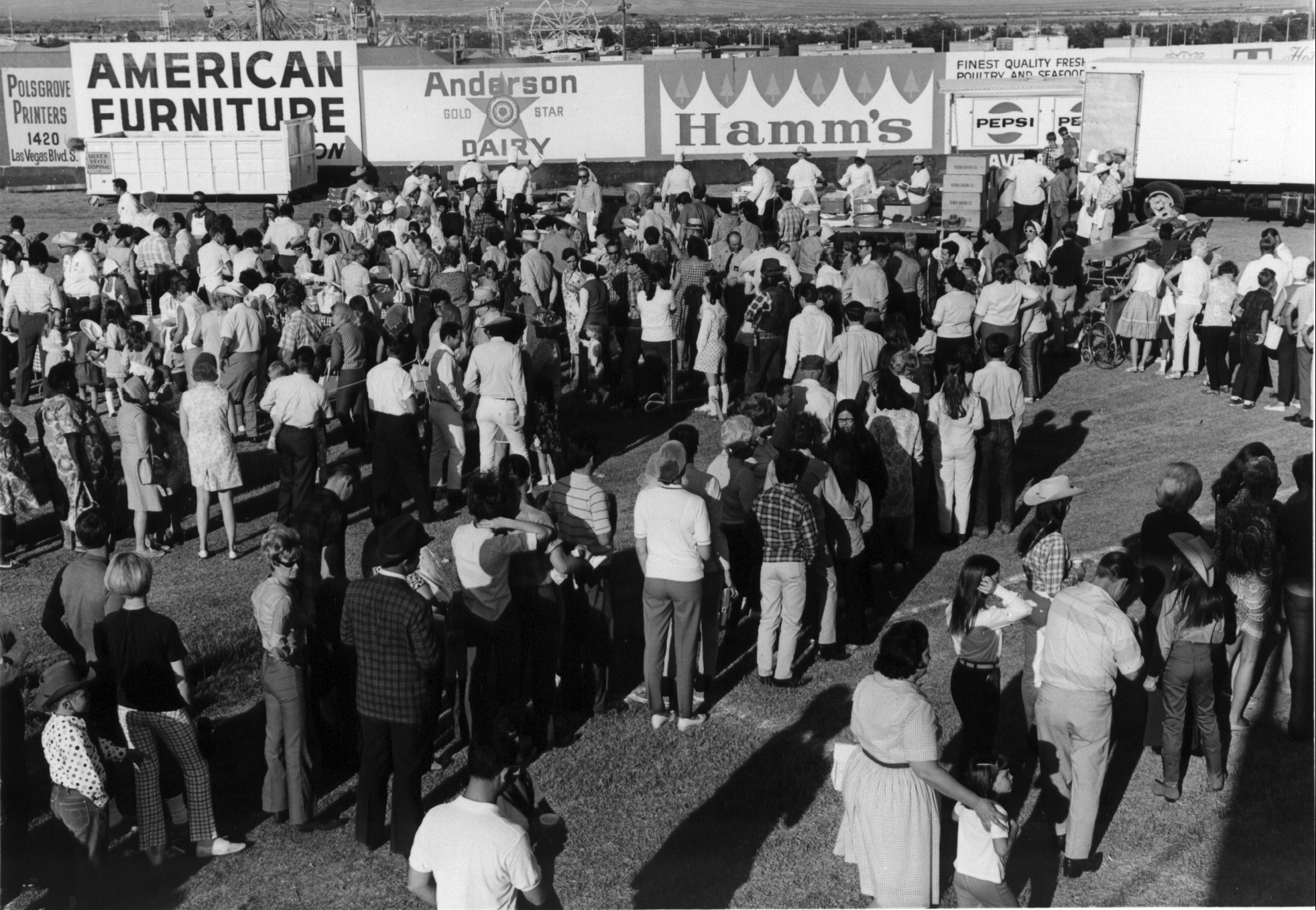
Onetime Cashman Field during Helldorado A Helldorado crowd at the old Cashman Field. Back in the day, the annual rodeo and funfair was held at this outdoor arena built past the Elks (the sponsors of Helldorado) nether the leadership of "Big Jim" Cashman, ane of the best boosters Las Vegas has always had.

Helldorado Hillbillies Band I of the many bands that played the fairgrounds during Helldorado Days at the quondam Cashman Field.
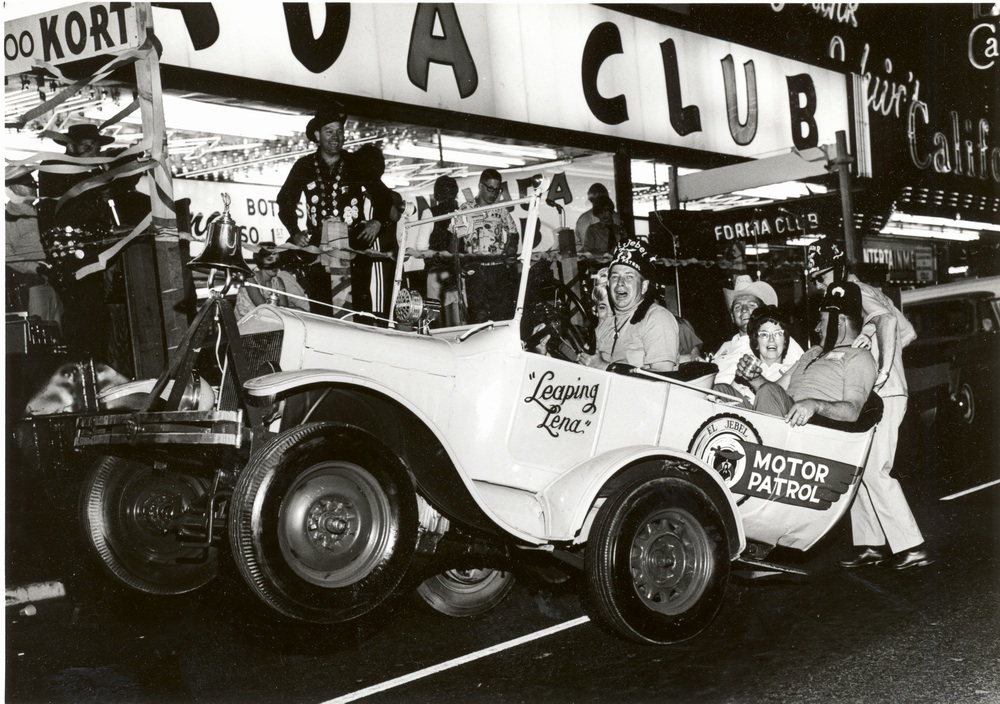
The Elks in their Leapin' Lena The Elks patrolled the Helldorado festivities in their Leapin' Lena motor patrol car. You didn't forget to buy your Helldorado button or you lot would end up in the hoosgow! (an old western term for jail)

Going to the Hosgow! These lovely ladies forgot the nearly important rule of Helldorado - buy a button or go to the hoosgow!

Rodeo Passenger at Cashman Field
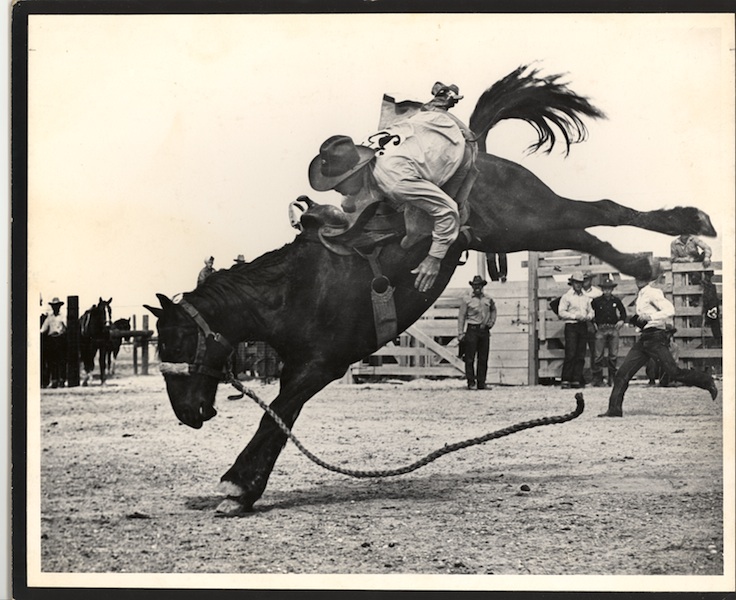
Rodeo Rider getting thrown Rodeo Passenger getting thrown at the Old Cashman Field during Helldorado days in the 1960s.

Rodeo passenger on bull horns Rodeo rider on bull horns at the old Cashman Field during Helldorado Days in the 1960s.
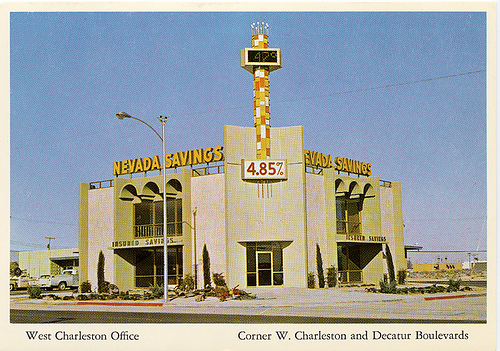
Nevada Savings and Loan This lovely buoy of mid-century modern stood for years at the corner of Charleston and Decatur before information technology was torn down for a drugstore.

Hyde Park School rendering Designed by local mid-century modern architects Zick and Sharp, Hyde Park schoolhouse was a model of efficiency when it opened. Located in the Southwest part of town, just off of Charleston Blvd, in what we would now call a pocket neighborhood, this school is still operational.

St. Anne's Church Saint Anne's Church building has been in the Huntridge/Marycrest neighborhood for over l years. Located just down the street from Bishop Gorman Loftier School, this is another fine example of mid-century modern compages that nevertheless stands.
Photo courtesy of the Nevada State Museum, Las Vegas
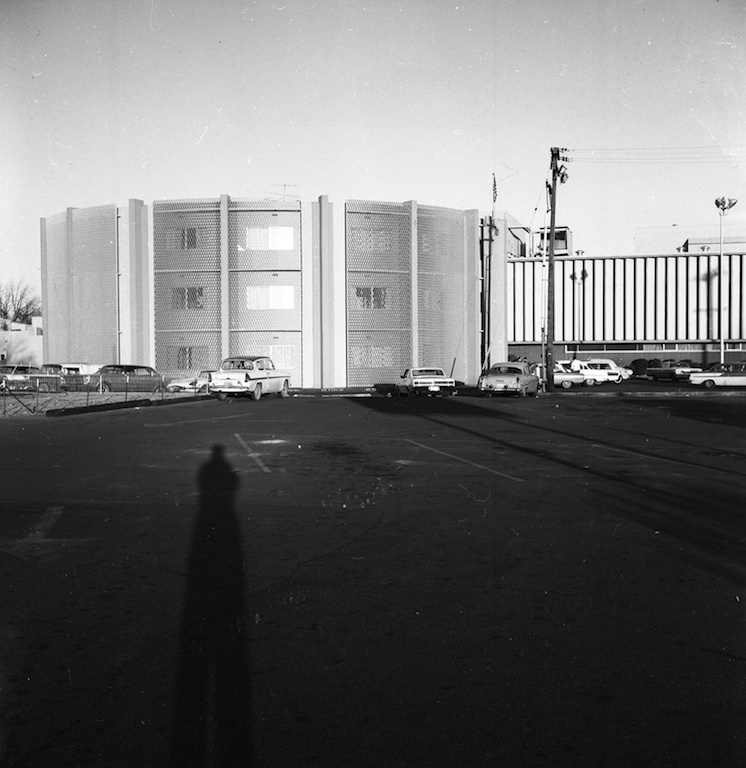
Southern Nevada Infirmary - Charleston Heights Another example of architecture by Zick and Sharp. A hospital has stood on this site for over seventy years. Southern Nevada Infirmary, at present UMC, was a land of the art hospital when it opened. Located on Charleston Blvd, only west of the throughway, the hospital and this building still stand!
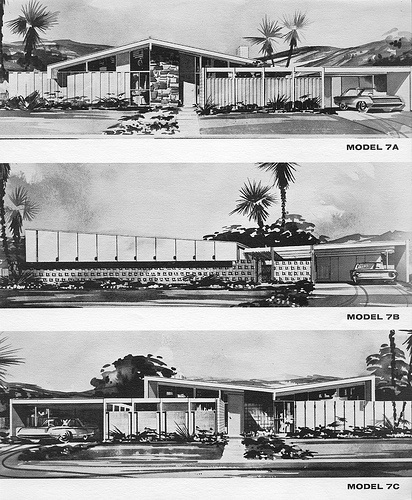
Paradise Palms Designed by Southern California architects, Palmer and Krisel and financed by Irwin Molansky, Paradise Palms was one of the premiere mid-century mod neighborhood in Las Vegas. Located just off Desert Inn Route between Maryland Parkway and Eastern, many of the houses especially around the National Golf Form, are yet standing.
Photograph courtesy of Dennis McBride
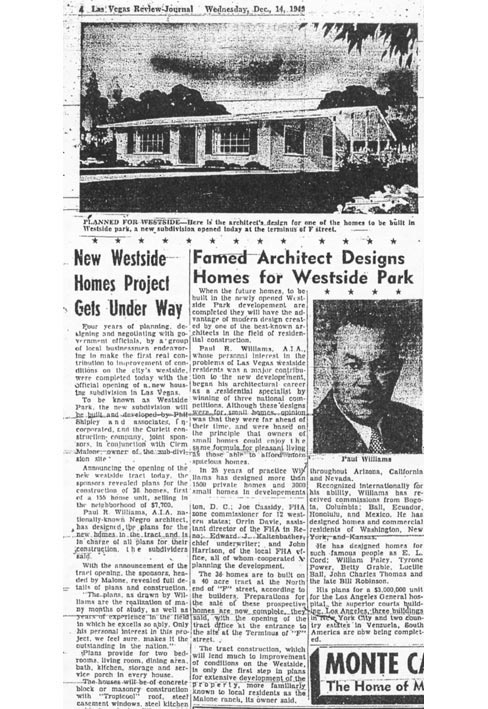
Berkley Square At present a historic neighborhood, this neighborhood, designed past African American architect, Paul Revere Williams, offered middle and upper middle class African Americans an upscale neighborhood freed of racial covenants that were common in other neighborhoods.

Stardust Memories On October 25th, at the Nevada State Museum, Las Vegas we held a lively panel give-and-take virtually the history of the legendary Stardust Hotel. Panelists included long-fourth dimension employees, performers and Jim Seagrave, long time publicist for the hotel.


Growing Up on the Walking Box Ranch This event was held April 28th, 2007 at the Clark County Heritage Museum.
The Walking Box Ranch was congenital in 1931 by western picture star, Rex Bell. He and his wife, silent moving-picture show star, Clara Bow, lived on the ranch and raised their two sons there. Throughout the 1930s the ranch, also home to some 1,800 head of cattle, served as an escape destination for some of the couple's famous Hollywood friends including Clark Gable, Carole Lombard, Errol Flynn and Lionel Barrymore. In addition, Rex Bell had a western wear store on Fremont Shop, was a yearly participant in the annual Helldorado Parades and was Lt. Governor.
Rex Bell, Jr grew upwardly at he sprawling 400,000 acre ranch. He went to unproblematic, heart school and 1 yr of high school in Las Vegas before going off to military school. He returned to Las Vegas and served as Clark County District Attorney before returning to private practice. Rex Bell, Jr shared stories of learning the ways of cattle, horses and people, reminiscences of ranch life and anecdotes of the ranch-bred organisation of values that followed him into the larger globe.

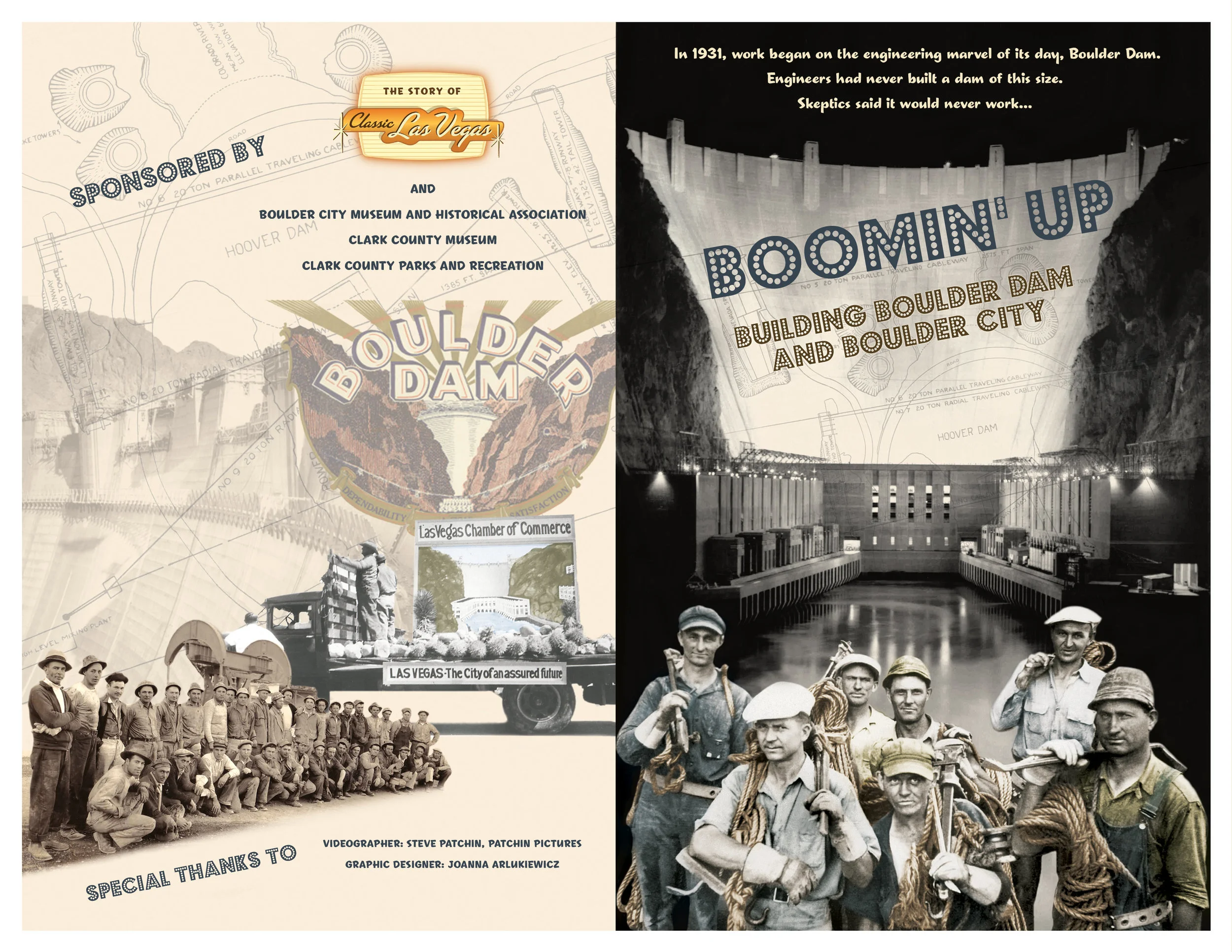
Boomin' Upwards: Edifice Boulder Dam and Boulder City Held on Oct seven, 2006 in conjunction with the Boulder Dam Museum and Historical Society and the Clark County Heritage Museum.
In 1931 work began on the engineering science modern marvel of its twenty-four hour period, Bedrock Dam. Engineers had never built a dam of this size. Skeptics said it would never work. But in the depths of the Low, construction workers and boilerplate joes heard the siren call of good wages and responded. Despite the backbreaking work, they came in droves hoping to get ane of the coveted jobs on the project.
In spite of the sweltering oestrus and primitive weather condition, men packed up their wives and children and brought them to a canyon on the Colorado River where the temperatures reached 120 degrees in the shade. Down in that location, on the canyon floor, in that location was no electricity, no running water, no air conditioning. Women set fiddling tent and box homes and fabricated practise with ingenuity and courage. The men went to work and the families endured the hottest summer on tape because there was no alternative.


So and Now: Growing Up in Early Las Vegas In partnership with the Nevada Country Museum, Las Vegas

Pioneering Women of Las Vegas Journalism Held March 21, 2007 at the Nevada Land Museum, Las Vegas.
From Florence Lee Jones Cahlan to Paula Francis, women have been at the forefront of journalism in Las Vegas. Every bit writers, reporters and boob tube anchors, they have worked hard to be taken seriously and to prove that they are as capable of doing the job as men.
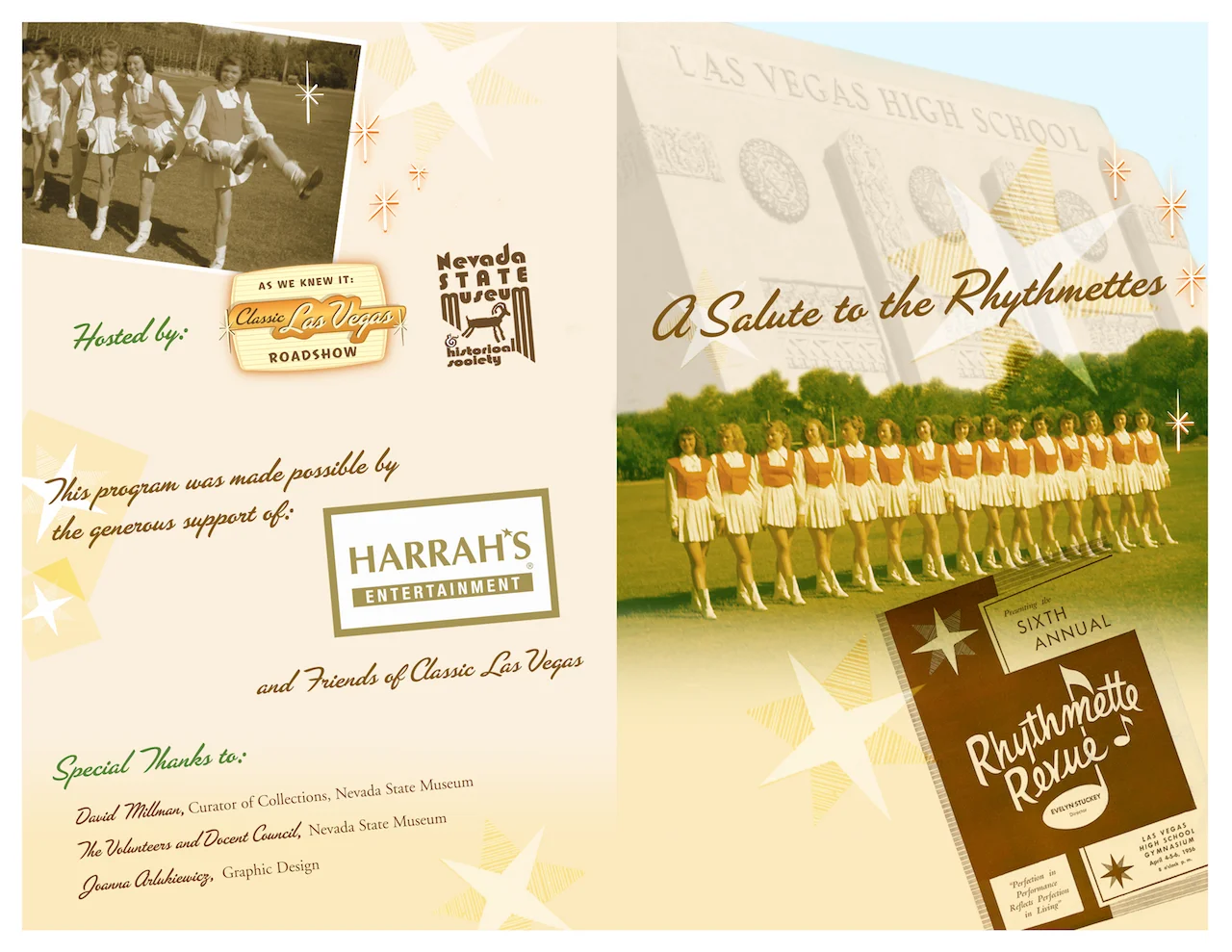
Salute to Las Vegas High School's Rhythmettes
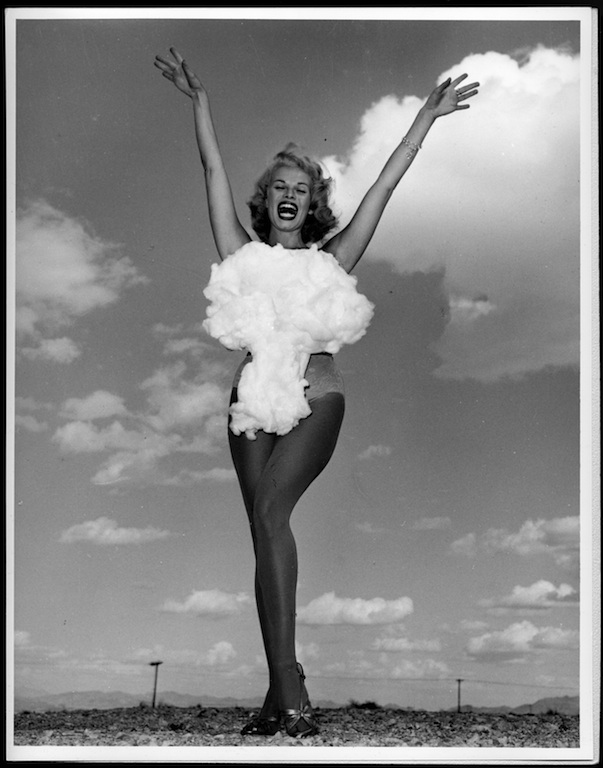
Miss Atomic Bomb The Las Vegas News Bureau photographers were always looking for a good idea for a picture- and photographer Don English language hit on a doozy. They talked a showgirl into pinning a cotton mushroom cloud to her swimsuit and so snapped this famous photograph that has come to define the Atomic Age of Las Vegas.
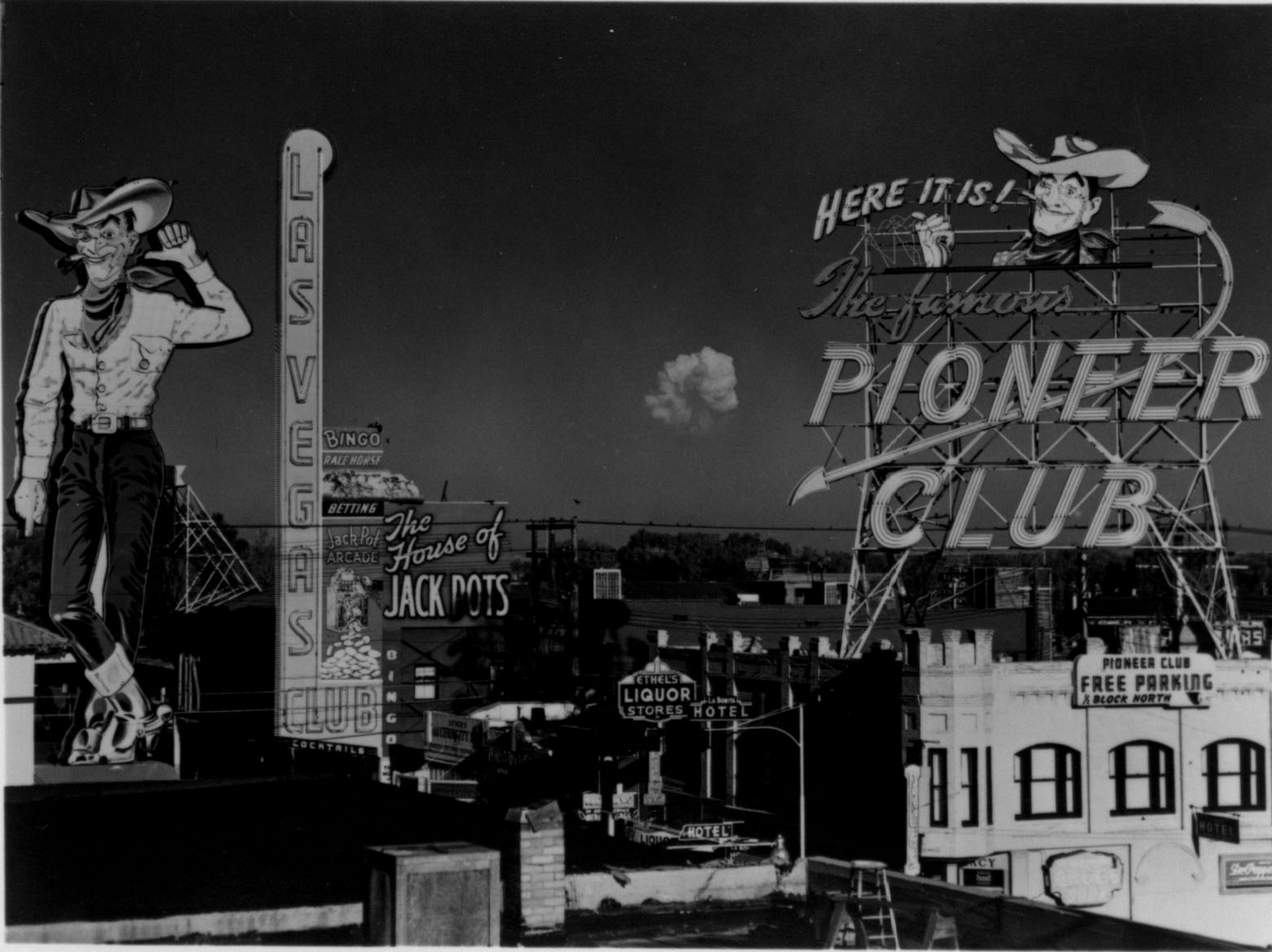
Atomic Bomb blast and Fremont Street This famous photo taken from a Fremont Street roof-acme was snapped by Don English, one of the best photographers with the Las Vegas News Bureau. Don had overslept the morning of the scheduled blast and hurried downtown in hopes of snapping a shot of the mushroom cloud he knew would soon be rising. The shot made the embrace of Life Magazine.

Don English at News Nob The Nevada Test Site was about an hour's drive out the old Tonopah Highway. News reporters and photographers from around the world would descend upon Las Vegas for the scheduled bomb blasts. They even had their own special viewing section affectionately called "News Nob". Hither is Las Vegas News Bureau lensman Don English hit a pose there.
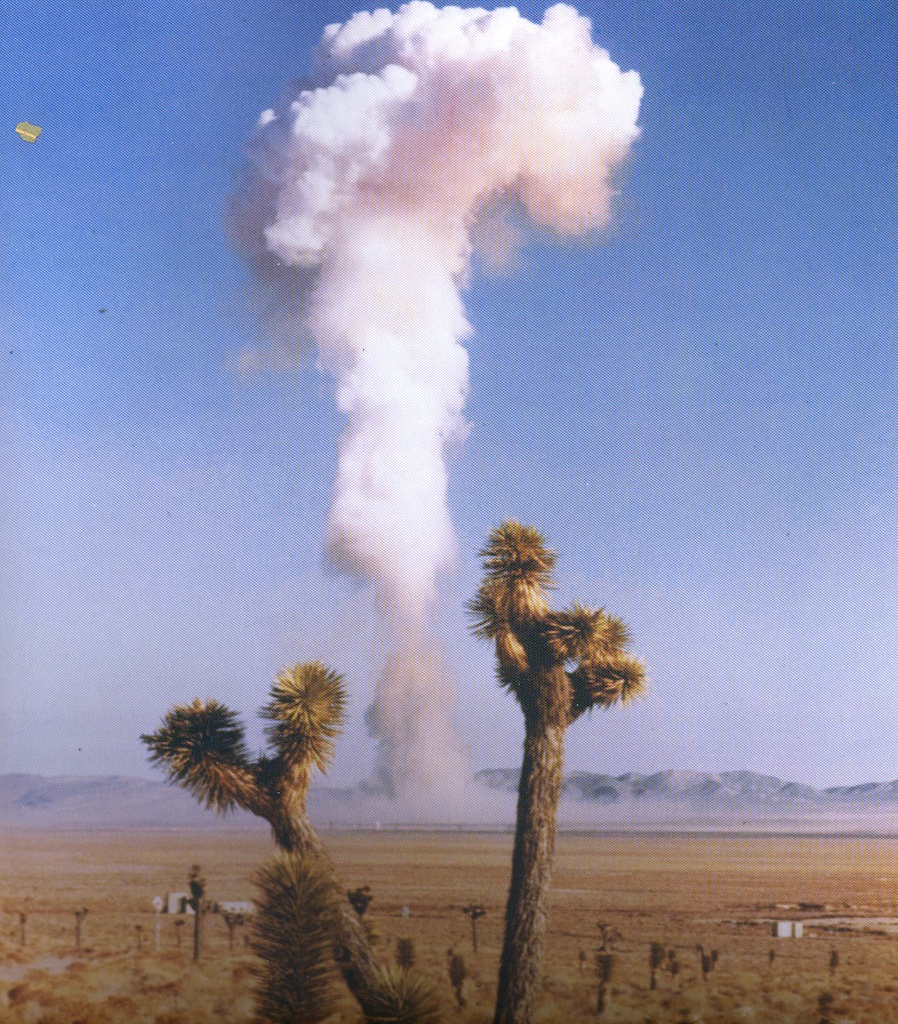
Mushroom Cloud Mushroom cloud from the Nevada Examination Site
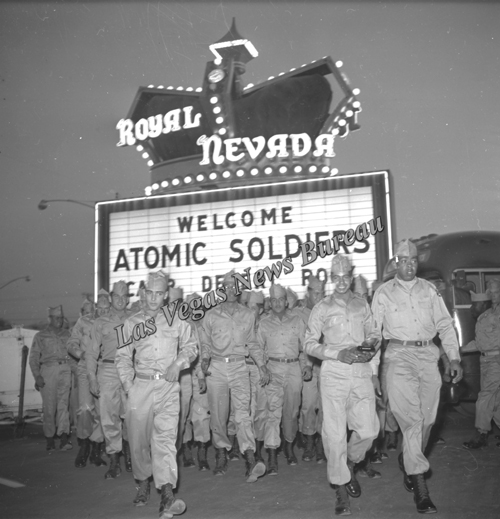
Royal Nevada welcomes Atomic Soldiers The soldiers who were stationed at the Nevada Test Site would frequently need a little rest and relaxation and the diverse Strip hotels would comp the grouping to a prove and drinks. Here is a group of soldiers at the Royal Nevada Hotel and Casino.
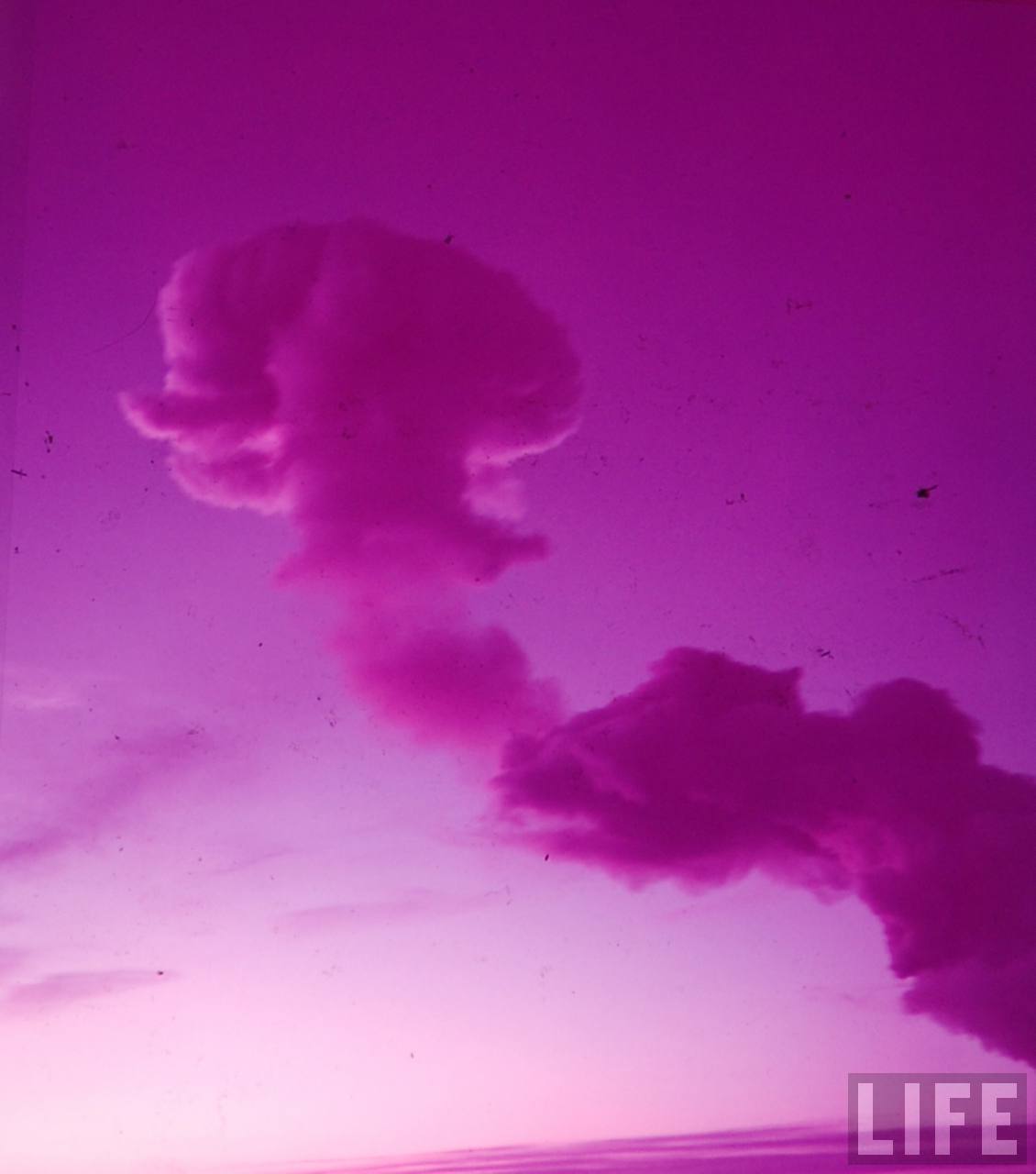
Mushroom Cloud This mushroom cloud fabricated the embrace of Life Magazine in the mid-1950s.
Photograph courtesy of Life Mag.


0 Response to "Metropolitan Museum of Art Construction Las Vegas Historical Photos"
Post a Comment