Wolves Home Again by Doug Shokes
T he get-go fourth dimension Marcos Rodríguez Pantoja ever heard voices on the radio, he panicked. "Fuck," he remembers thinking, "those people accept been inside there a long fourth dimension!" It was 1966, and Rodríguez woke from a nap to the sound of voices. In that location was nobody else in the room, just the sounds of a conversation were coming from a small wooden box. Rodríguez got out of bed and crept towards the device. When he got closer, he couldn't see a door, a hatch, or even a small crack in the box'due south surface. Nothing. The people were trapped.
Rodríguez had a plan. "Don't worry, if yous all move to one side, I'll get you out of there," he yelled at the radio. He ran towards the wall at the other end of the room, the device in his hand. At that place, incoherent and red in the face, he held it high above his caput and brought it downwardly hard confronting the brick wall, in one violent swing. The wood splintered, the speaker popped out of its casing, and the voices savage silent. Rodríguez dropped the radio on to the flooring.
When he knelt down to search through the droppings, the people weren't in that location. He called for them, but they didn't respond. He searched more frantically, but they nevertheless didn't appear. "I've killed them!" Rodríguez bellowed, and ran to his bed, where he hid for the rest of the twenty-four hour period.
Rodríguez was in his early 20s. He did non accept any learning disabilities. Indeed, there was nothing to suggest his intelligence was below average. Simply he was ignorant of the most basic technology because, between the ages of seven and 19, according to his ain testimony, Rodríguez lived alone, far from culture, in the Sierra Morena, a deserted mountain range of jagged peaks that stretches beyond southern Espana.
His story is that he was abandoned as a child of seven, in 1953, and left to fend for himself. Alone in the wild, as he tells it, he was raised by wolves, who protected and sheltered him. With no 1 to talk to, he lost the apply of language, and began to bawl, chirp, screech and howl.
Twelve years afterward, police found him hiding in the mountains, wrapped in a deerskin and with long, disordered pilus. He tried to abscond, only the officers caught him, tied his easily and brought him to the nearest village. Eventually a young priest brought him to the infirmary ward of a convent in Madrid, where he stayed for a year and received a remedial education from the nuns.
It is almost incommunicable to imagine what information technology would be like to sally into adulthood without whatever of the socialisation that the residue of us unconsciously absorb, via a meg imperceptible cues and incidents, every bit children and teenagers. When he left the convent infirmary, adjusting to life among humans brought with it a series of shocks. When he first went to the cinema – to see a Western – he ran out of the theatre because he was terrified of the cowboys galloping toward the photographic camera. The offset time he ate in a restaurant, he was surprised he had to pay for his food. I day he went into a church, where an acquaintance had told him God lived. He approached the priest at the altar. "They tell me you're God," he said. "They tell me you know everything."
In the 50 years since he was found in the wilderness, Rodríguez has struggled to go a handle on society's expectations. He lived in convents, abandoned buildings and hostels all over Spain. He worked odd jobs on structure sites, in confined, nightclubs and hotels; he was robbed and exploited: people took advantage of his unworldliness. Some people did endeavour to assistance him, but almost found him bad-mannered and uncommunicative, and he was largely shunned past society. "For most of my life," Rodríguez told me, "I had a very bad fourth dimension amid humans".
M arcos Rodríguez nonetheless finds information technology difficult to be human. He lives in Rante, a sleepy village of 60 or so families in Galicia, in north-westSpain. He is retired, and spends his time walking in the countryside, at the bar – "where he likes to play the clown," a waitress told me – or hunting wild boar with a friend. The rest of the time, he stays abode, watching daytime TV for hours. Rodríguez moved here in the late 1990s, when he was taken in by a retired policeman, who brought him to Galiciaand gave him a task doing farm work and a place to live. For the first fourth dimension since he left the mountains, his life was placidity and peaceful. "The people go on an centre out for me hither," he told me. "They're nice, better than those I met before."
I met Rodríguez in his cramped, cold living room. The walls were plastered with photographs, old magazine pages and calendars of naked women. "I'chiliad too much of a human being now," he said. "Before, when I get-go started living amidst people, I didn't even take a bed– I slept on piles of newspapers." The small, ordinary house was given to him six years ago past i of his friends in the village. There were dirty plates in the kitchen sink, a half-fabricated bed, wooden cupboards, a deskand a Telly.
Talking with Rodríguez is somewhat uncanny. Zippo about his advent suggests an unusual past: he looks similar a typical Castilian septuagenarian, sparse, with common salt-and-pepper pilus and reddish cheeks. A cigarette habitually protrudes from his thin lips. But within moments of meeting him, I could sense something different in his demeanour.
He found it hard to expect me in the eye, and stared intensely at the ground whenever he spoke. He would make a joke, and laugh at himself, only to lose his confidence almost immediatelyand retreat backside a sheepish, diffident grin. He was friendly and talkative, but he seemed overly conscious of my reaction to everything he said: if I looked dislocated, he was visibly discouraged; if I was enthusiastic, he was suddenly excited and energetic. He e'er seemed to be anticipating his interlocutor's scorn.
In his company, y'all cannot aid realising that our daily interactions are eased past a stream of invisible signals – a kind of silent linguistic communication we all understand, which yous don't even detect until information technology'due south absent-minded. "Marcos tin can start seem unknowable, and difficult to help," Xosé Santos, one of his friends in the hamlet, had told me. "But one time he gets to know you, and yous him, he is a very loyal person."
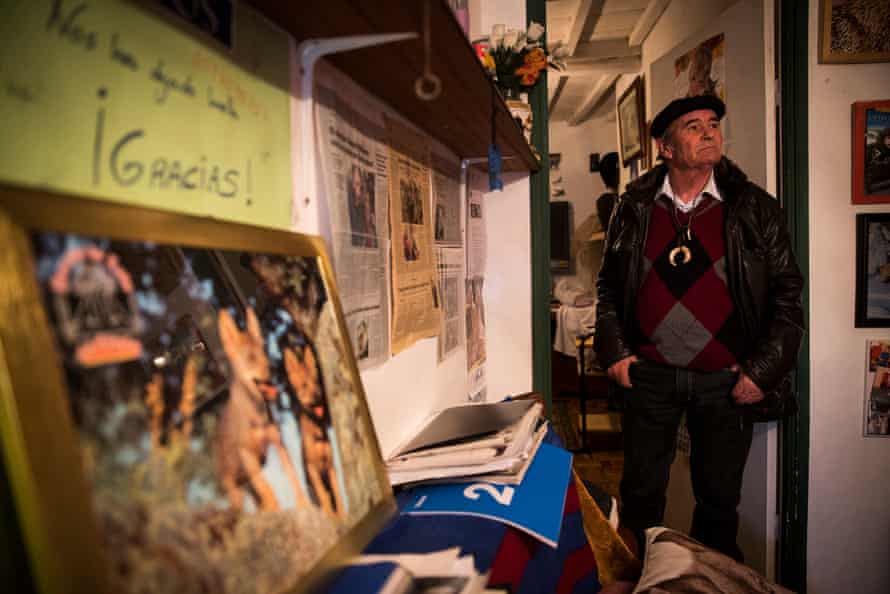
Rodríguez drew a lighter towards his cigarette and struck. "I'm still amazed by these things," he chuckled, pointing at a large collection of lighters on a nearby shelf. "If you lot only knew the lengths I went to to make fire back then." On the desk backside him is a pile of cuttings from Spanish newspapers, with headlines such as "The Wolfman of the Sierra Morena" and "Living Among Wolves" – mementoes of a bewildering new period in his life.
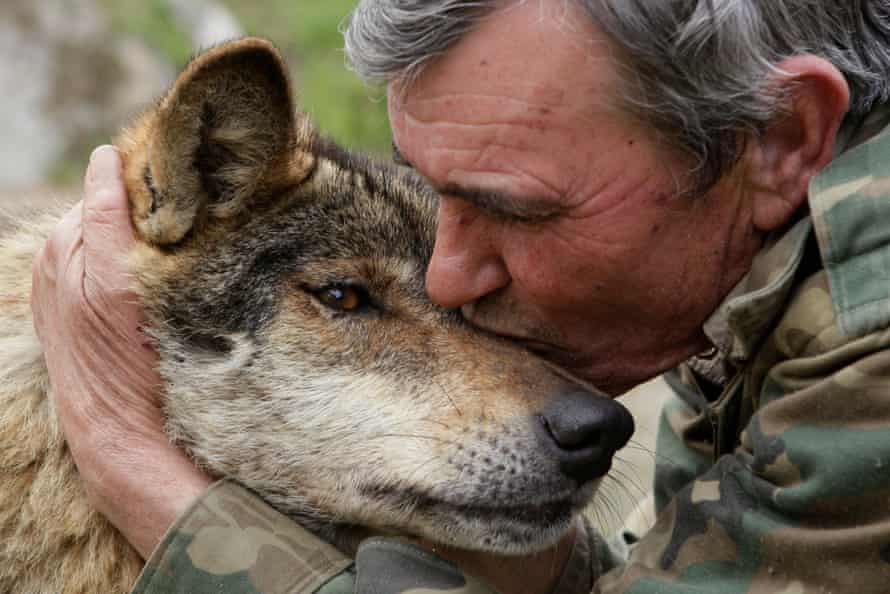
In 2010, the Castilian director Gerardo Olivares released a picture show, Entrelobos ("Amidst Wolves"), based on Rodríguez'southward life in the mountains. After reading his story in a book by Gabriel Janer Manila – a Castilian anthropologist who wrote a PhD thesis based on extensive interviews he conducted with Rodríguez in the 1970s – Olivares hired a individual detective to track down Rodríguez. "I did not have much hope of finding him," Olivares told me. "Manila told me he was dead."
The movie, which was a modest hit in Spain, was a heavily romanticised delineation of Rodríguez's coexistence with nature, with the story told through the optics of the "wolf child". "Some details were missing, but I do like information technology," Rodríguez told me. "I sentry it all the fourth dimension, especially when I'm sad or can't go to sleep." (Olivares went on to make a documentary nearly Rodríguez, called Marcos, el Lobo Solitario.)
Suddenly, to his shock and dismay, Rodríguez became a celebrity: Spanish Goggle box declared him the "son of wolves"; the BBC dubbed him "the wolf human being". Spanish papers seemed to write near him every other month. At offset he was pleased with the attention: after years of rejection and disbelief, his story was existence told, and he was finally being accepted. Merely soon, people wanted more of him than he could give. Journalists were lined upward outside his door, and the printing wanted to find out everything about his life. Fans wrote him from Germany, America and all over Espana. He was the famous wolf man of the Sierra Morena.
What Rodríguez remembers of his time living wild is that information technology was "glorious". When he was found by the police force and brought down from the mountains, an untroubled, simple adolescence among animals and birds was cruelly cut curt. He had always found information technology hard to relate to humans, who were baffled by his ignorance and infuriated by his inability to communicate. But now the intensity of their belated fascination was almost as puzzling equally their before contempt – Rodríguez could never empathise what was expected of him.
Rodríguez speaks in a high pitch, oscillating between seriousness and frivolity; a sober tone can plough quickly into a raucous express mirth. But he is quiet and solemn when he tries to explicate how he suffered at the easily of humans later he returned to society: "I was constantly humiliated. Among people, I learned to hate and to exist embarrassed."
No one believed his story; they merely took him for an idiot or a drunk. He wanted to be liked, to exist normal, to accept a wife and children. He wanted everything he seemed utterly incapable of having. Merely when Rodríguez thinks about what has hurt him most in life, what he returns to aren't these everyday humiliations, but one earlier betrayal: when his father sold him into slavery.
R odríguez was born on eight June 1946 in a squat, whitewashed firm in the village of Añora in Andalusia. His parents, Melchor and Araceli, had ii other boys. The rural economy had collapsed after the civil war, and life was harsh. "The family were poor, and they left for Madrid, in search of work," Anastasia Sanchez, Rodríguez'south cousin, told me.
In the majuscule, Melchor found work in a brick factory, but before long after the family arrived, his wife died. According to Sanchez, Melchor couldn't cope on his own. He soon met another woman and sent one of his sons to alive with his family in Barcelona, and left another with relatives in Madrid. (Juan, the merely surviving brother, did non respond to requests for an interview).
Melchor kept Marcos with him, and together the new family unit returned to the south, to Cardeña – well-nigh 50km east of his birthplace. Melchor took a job making charcoal. Rodríguez, at the age of four, took intendance of the family'due south pigs. He would exist sent to steal acorns from the landowner's estate to feed them. "If I didn't bring enough home, my stepmother wouldn't requite me whatever dinner," he told me. She beat him oftentimes.
So, 1 day – Rodríguez thinks he was about six – a man arrived on a chestnut horse. The man spoke briefly with Melchor, so took the kid habitation with him. Rodríguez had never been in such a large house. In a sprawling kitchen, he was fed a thick, meaty stew. The human told him his male parent had sold him. From now on, the rich human said, the boy would piece of work for him, disposed his herd of 300 goats. "And that was it," Rodríguez told me. "I never institute out how much my Dad was paid."
Julian Pitt-Rivers, a British anthropologist who published a archetype study of a traditional Andalusian community in the early 1950s, wrote that it was common in the rural south for children from impoverished families to be sent to the mountains to look after sheep and goats in substitution for coin. "At that place were lots of young boys working and sleeping on the hillside back then," Juan Madrid, a civil servant in Añora who has researched Rodríguez'southward case, told me. "But that his father sold him – I'thou not certain that was so common."
The next forenoon the man took him on horseback into the mountains, to a pocket-sized cave deep in the Sierra Morena, a sparsely populated mount rangefull of wolves and wild boars. There, Rodríguez was handed over to the care of an elderly shepherd. He slept outside, and at first was frightened past the animal noises. The taciturn old shepherd gave him goat's milk to drinkable, and taught him how to trap hares and light fires.
Simply ane day not long after Rodríguez arrived, the old shepherd said he was going off to shoot a rabbit and never returned. Nobody came to replace him. The landlord appeared from time to fourth dimension to check on the goats, but Rodríguez hid from him. He didn't want to be taken back to his family home, where he had suffered years of beatings. "Fifty-fifty in my worst moments, I preferred the mountains to the idea of abode."
In the following weeks, the young male child tried to suck milk from the goats. He tried to catch pheasants and fish for trout, but had little success. So, instead, he started following the lead of the animals. He watched how wild boars dug for tubers and how the birds picked berries from bushes. With the basic knowledge he had learned from the shepherd, he improvised traps for rabbits and noticed that when he gutted them in the river, their blood attracted the fish. When he got older – Rodríguez couldn't remember how old – he too learned how to hunt and skin deer.
He told me he was still a child, just six or vii, the first time he encountered wolves. He was looking for shelter from a storm when he stumbled across a den. Not knowing whatever improve, he entered the cave and barbarous comatose with the pups. The she-wolf had been out hunting, and when she returned with food, she growled and snarled at the boy. He idea the wolf was going to attack him, he says, simply she allow him take a piece of the meat instead.
Wolves are not the only animals he lived among: he says he made friends with foxes and snakes, and that his enemy was the wild boar. He says he spoke to them all in a mix of grunts, howls and half-remembered words: "I couldn't tell you what language information technology was, but I did speak."
Rodríguez told me this with absolute confidence, as if zippo could have been truer. The fact that I might find information technology implausible didn't seem to worry him; it was the i moment when he showed absolutely no business for my reaction. At that place was no blushing, no adolescent timidity or raucous, incoherent humour. Indeed, if there was one thing Rodríguez seemed to know for certain – no matter what other people thought – it was that he had lived a meliorate and happier life in the wild. The complexity of his interactions with humans would later on grate against the remembered simplicity of his dealings with the animals. "When a person talks, they might say ane thing but mean another. Animals don't do that," Rodríguez told me.
I due north early 1965, a park ranger reported to the police that he had seen a man with long hair, dressed in a deerskin, roaming the Sierra Morena. Three mounted officers were sent to search for him. Rodríguez says they found him eating fruit under the shade of a tree deep inside the Sierra. He remembers the men dismounted their horses and tried to talk to him, merely Rodríguez didn't know how to respond. He understood their questions, merely he hadn't spoken in 12 years, and no words came. He ran.
The officers defenseless up with Rodríguez hands. They tied his hands to the saddle of one of their horses and dragged him off the mountain; Rodríguez told me howled every bit he left the hillside.
First, the officers took him to a nearby boondocks, Fuencaliente, and brought him to a barbershop. "I was sitting in the chair, and I call back looking in the mirror and wondering who was staring back at me." When the barber took out a razor and began to sharpen it, Rodríguez lunged at him. "I idea it was either him or me," he recalled. The two officers had to restrain him.
Then, Rodríguez remembers, he was taken to the local jail in Cardeña, about 20km away, while the officers searched for his father. Merely when they eventually tracked Melchor down, they did not charge him for selling his own son into slavery – they only asked if he wanted the boy back.
Instead of welcoming his son with open arms, his father was indifferent. (In fact, Rodríguez recalls, his father berated him for losing a jacket he had been given every bit a child.) When the police saw that Melchor had no interest in him, they simply left him in the main square of Cardeña. Ii shepherds known locally as the "widowers" took him in, and put him to piece of work tending their sheep. Simply a few days afterwards his capture, Rodríguez was back in the mountains, looking subsequently animals again.
In the spring of 1966, the shepherds Rodríguez was working for moved their flock near the village of Lopera, where there was good grazing. The son of the local doctor, a curate named Juan Luis Galvez, encountered Rodríguez, scared and still unable to speak. It was a year since he had been discovered in the mountains, just he had still hardly spent any fourth dimension with humans.
Galvez told Gabriel Janer Manila, the anthropologist, that he was at offset utterly "unadapted to social norms", seemingly allowed to the cold, and walked with the hunched, bow-legged gait of a monkey. Galvez moved the fellow into his family home in Lopera, where he taught him how to dress himself, how to eat correctly, and how to pronounce words. He even arranged football matches so Rodríguez could play with other local children. But Rodríguez resisted. "I would try to run back to the mountains whenever I could," he told me. "I didn't feel comfortable among humans."
When Janer visited the area a decade later to ostend the details of Rodríguez's stories, he found "a powerful reluctance to talk about this period", and particularly the circumstances of his abandonment and capture – a sign of shame about the misery and poverty that haunted the region in the years after the ceremonious war. These socioeconomic weather, Janer wrote, were essential to understanding the trauma of Rodríguez'due south early life.
Joaquin Pana, a priest in Lopera, told Janer that the young Rodríguez "had been treated very badly by people", and seemed to exist surprised past everything, whether it was a glass of wine, a cigarette, or a broom: "He had the listen of a very, very immature child." A local woman called Maria Antonia Cerillo Uceda remembered Rodríguez equally "very scruffy and wild", but likewise "clever and curious".
At the end of the summer of 1966, Galvez, the curate, sent Rodríguez to the Hospital de Convalecientes in Madrid, a convent infirmary on Meléndez Valdés Street in the n of the city. At that place, doctors cut the calluses from Rodríguez's feet and placed a board on his back and so that he would stand straight, and the nuns carried on his linguistic communication lessons.
Rodríguez was perfectly capable of understanding language; the trouble was simply that he hadn't spoken for so long that he had lost the power to pronounce words. "I talked before they captured me, and fifty-fifty in the mountains, I spoke to myself," he told me. But he never seemed to catch upwardly, fifty-fifty after many years in the globe. "I e'er felt I never had cognition of anything that mattered to people," Rodríguez told me. "The only thing I knew was my life in the mountains, and nobody believed me."
'Y ou know, the first fourth dimension I saw the sea, I was travelling to Mallorca on a ferry from Barcelona," Rodríguez told me one evening over dinner. "I was so confused past the never-ending water that I went to one of the sailors and asked him why there was and then much h2o surrounding the boat. The crewman turned to me and smiled; he must have known I was unlike. 'We tied the water to the boat,' the homo said to me, pointing to 1 of the ropes hanging off the gunwale." Rodríguez cackled, shook his head, and took a swig of his vino. "Poor nuns," he said, "they tried their best, merely they didn't ready me much for the real world."
While Rodríguez stayed at the convent, he worked on construction sites in and around Madrid. The nunshad hoped this would prepare him for club, but it didn't help much. "I never had whatever idea what I was supposed to practise," he told me. At the get-go of 1967, Rodríguez was sent to practise war machine service in Córdoba. He didn't last long. He fired his gun during a training drill and almost killed a member of his platoon. He was discharged, and returned to the hospital in Madrid. On his return, he met a fellow patient who convinced him to go to the island of Mallorca – which was and so turning into a tourist destination for people from all over Europe. At that place would be lots of piece of work, the human being told Rodríguez, and he could finally have some independence.
As shortly as they arrived on the island, his travelling companion stole his suitcaseand the little money the nuns had given him, and left him stranded in a hostel. The owners, who thought Rodríguez was pulling a scam, chosen the police. "Luckily the nuns had chosen ahead to warn the local constabulary of my arrival," he told me. Instead of being arrested, he was put to work to pay off his debts.
In the following years, he held jobs as an banana chef, a barman, a stonemason and a route-sweeper. Because he didn't sympathize money very well, his bosses often underpaid him and took advantage of his naivety. "For a while, I was selling marijuana, without knowing. My dominate told me it was stomach medicine. People would come to the bar and ask for 'medicine', and I'd requite it to them."
Juan Font, who worked with Rodríguez on building sites on the island in the 1970s, remembers him as mischievous and funny, but easily exploited. "He was a practiced person and a difficult worker, who nosotros all respected," he told me over the phone from Mallorca. "I recall he loved to sing; he had a swell voice. Simply it was hard to believe his stories of living in the mountains; they only seemed and then unreal."
It was in Mallorca, in 1975, that Rodríguez was introduced to Gabriel Janer Manila, the anthropologistwho would go on to producethe most meaning written report of his life in the wild and its effect on his subsequent evolution.
"Here was this fragile-looking, childish man who was telling me the well-nigh incredible tales," Janer told me on the phone. "I admit, I struggled to believe him." But the more Janer heard of Rodríguez's story, the more credible it seemed. The pair met almost every day for six months. "I noticed that his story never varied, the facts never changed, no matter how many times I asked him to tell it, no matter how many times I asked him to clarify something," Janer wrote in his PhD thesis.
After subjecting Rodríguez to a series of intelligence tests, Janer adamant that Rodríguez had no learning disabilities. Instead, he concluded, his emotional and social evolution had remained frozen at the moment in his childhood when he was abandoned. Rather than learning the rules of human interaction, Janer wrote, he idealised life among the animals. "Even now," he concluded, "Marcos tries to utilize to social life the rules he observed during his life in the mountains."
Of class, the question remains: did Rodríguez really communicate with the animals in the way he remembers it? Certainly, the idea has fired the imagination of fiction writers. But for scientists, the question of whether animals would ever permit a human to live among them, equally 1 of their own, is still the subject of fierce debate.
When a minor kid was discovered in a forest near Kampalain Uganda in 1991, the adult female who found him described an emaciated boy, covered in pilus and missing a big toe. When she tried to touch him, he screamed similar a banshee. At first, the male child, who was given the name John Ssebunya, didn't speak much, merely with the intendance of his adoptive family unit, he regained parts of his spoken language and was able to tell people what had happened to him. Ssebunya claimed that monkeys had raised him – that they brought him foodand containers of water made of giant leaves, and that he played hide-and-seek with their young.
Douglas M Capland, a primatologist and psychologist who studied Ssebunya's case, believed that the boy lived alongsidemonkeys, only not among them. The monkeys, Capland ended, had foraged more food than they needed, and John had picked up what they left behind.
José España, a biologist and specialist in wolf behaviour, who knows Rodríguez, believes his experience was probably comparable. "It'due south very possible for humans and wolves to co-be," Espana told me. "Just do I believe that every fourth dimension he called the wolves they came to him, as he says? Well, that'south more than debatable." Certainly, the wolves would take come to Rodríguez when he had food. "Marcos is what I would call a periphery wolf – tolerated by the alpha, and by the rest of the pack because he posed no threat," España said. "How he chose to interpret these interactions, all the same, is well-nigh likely a case of selective memory."
Janer says the immature boy would have projected his social needs on to the animals and imagined relationships with them. "When Pantoja says the trick laughed at him, or that he had to tell off the snake, he gives us a version of the true reality, what he believes happened – or how, at to the lowest degree, he explained the reality to himself," Janer told me. "Marcos's mind was desperate for social credence," he told me, "so instead of understanding the animals' presence every bit incentivised by the food, he thought they were trying to brand friends."
R odríguez left Mallorca in the 80s and moved to the south of Spain, where he worked in a series of jobs – "anything that didn't involve reading or writing," he said. He was at his local bar almost every 24-hour interval, getting drunkard and playing the fruit machine. "This was the time that Marcos's life passed in a blur of alcohol and odd jobs," Gerardo Olivares told me. Rodríguez finds information technology difficult to recall much of those years – except the solar day he met the man he calls "my dominate".
In 1998, a retired policeman from Galicia, Manuel Barandela, was visiting his son in the town of Fuengirola, near Malaga, when he spotted Rodríguez living in the basement of an abandoned building. They talked over tiffin, and Rodríguez gave him Janer's book to read. Later on struggling through his story with the help of a Catalan dictionary, Barandela decided to accept him back to Rante, where he could offer him a habitation and requite him piece of work on his homestead.
In Rante, Rodríguez establish quiet and confinement for the get-go time since his capture. Barandela tried to teach him to read, then that he could at least use the phone and recognise the names of medicines, simply it proved well-nigh incommunicable. Barandela found information technology hard to talk to him, and began to worry it had been a mistake to have him in. "In the cease, I came to encounter Marcos as a child," he recalled in a Spanish interview in 2010, soon before he died. "Agreement him this way made everything easier."
Of form, it is as a "child" that Rodríguez has now become an object of fascination. For centuries, writers and thinkers have been obsessed by the stories of "feral children"who grow up without human contact, supposedly untouched by civilisation – and therefore taken to stand for human nature in its purest form, innocent of guild'due south workout.
Victor of Aveyron, peradventure the virtually celebrated feral child of modern times, emerged from a forest in southern France in 1800, aged 12, after about vii years living in the wild. This was a moment of social and philosophical ferment, when ideas about the "state of nature" put forth by the likes of Locke and Rousseau were yet existence hotly debated. Victor, who was unable to speak, was hailed throughout the country as a potential window on to man's soul, and intently studied past learned men keen to test their theories of language and education.
It may be no blow that Rodríguez's example was, for half a century, rather less historic: he emerged from the mountains into a country scared to investigate itself for fear of what it might find. There was little appetite for reopening debates near poverty and neglect, or the auction of children into labour, even in the 1970s. Information technology was not until much later, 35 years afterwards Franco had died, in a democracy mature enough to confront its past, that the details and significance of his story were finally embraced.
The release of Entrelobos, and the sudden alluvion of involvement in the circumstances of Rodríguez'southward abandonment, brought back to life a forgotten Spain, cut off from the world, struggling to survive on scarce resources under a repressive dictatorship. Rodríguez told Olivares that he had given him dorsum his dignity. The innocence and naivete that had fabricated him an outcast his whole life were at present the subject of intense interest.
Merely this was however another complication: it seemed as if people thought their attending could compensate for all his suffering. People wrote to him from all over the world: some wanted to understand him, some wanted his advice, and some said they wanted to take intendance of him. Schools asked him to visit to tell his story to their pupils. His phone filled upward with letters from journalists wanting a more than intimate account of his life. "There was a queue outside as long every bit the i at a benefits part," Rodríguez said, slumped in the chair in his small living room.
"People still come round all the fourth dimension. Some of them remember I'm rich and try to exploit me. I don't accept a penny!" Rodríguez told me. He remembered ane occasion, a few years back, when a woman visited his house and alleged her love for him. "She offered herself to me and said that we should go into business together. I suppose she thought I made loads of money from the picture!"
Rodríguez could non understand how his story could be met with complete indifference for decades, only to make him famous twoscore years later on Janer starting time wrote most information technology. "Specially when I hadn't inverse," he said. To him, all this newly discovered adulation seemed just some other hurtful, incomprehensible quirk of the human mind.
From the window of Rodríguez'southward firm, I saw that the morning frost had lifted, and the sun bobbed above. The house had no central heating, and the crisp February air collected in dense clouds around his olfactory organ and oral fissure equally he spoke. "You know, at kickoff they didn't want to mind to a word of what I was saying. Now, they can't stop listening. What is it they actually desire?"
Source: https://www.theguardian.com/news/2018/aug/28/how-to-be-human-the-man-who-was-raised-by-wolves
0 Response to "Wolves Home Again by Doug Shokes"
Post a Comment